Last updated October 31, 2026
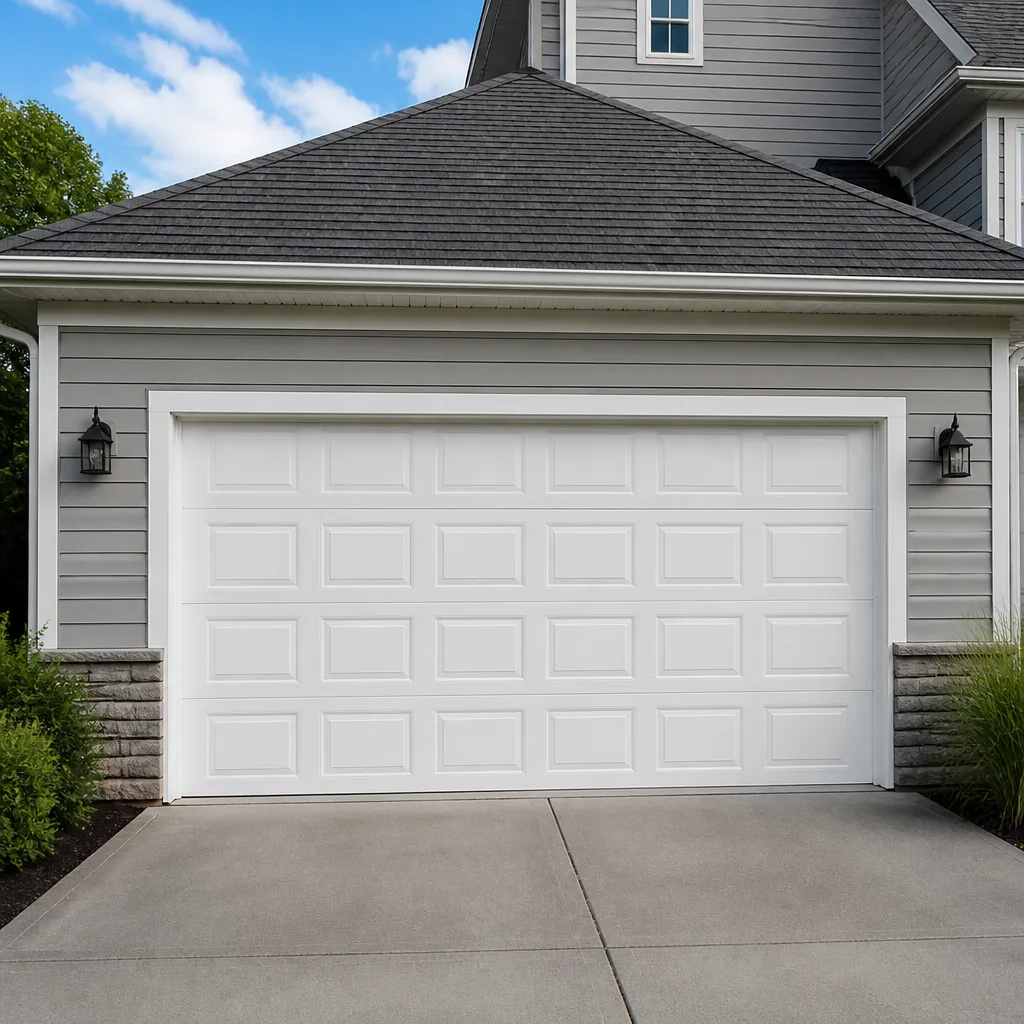 Raised-panel steel
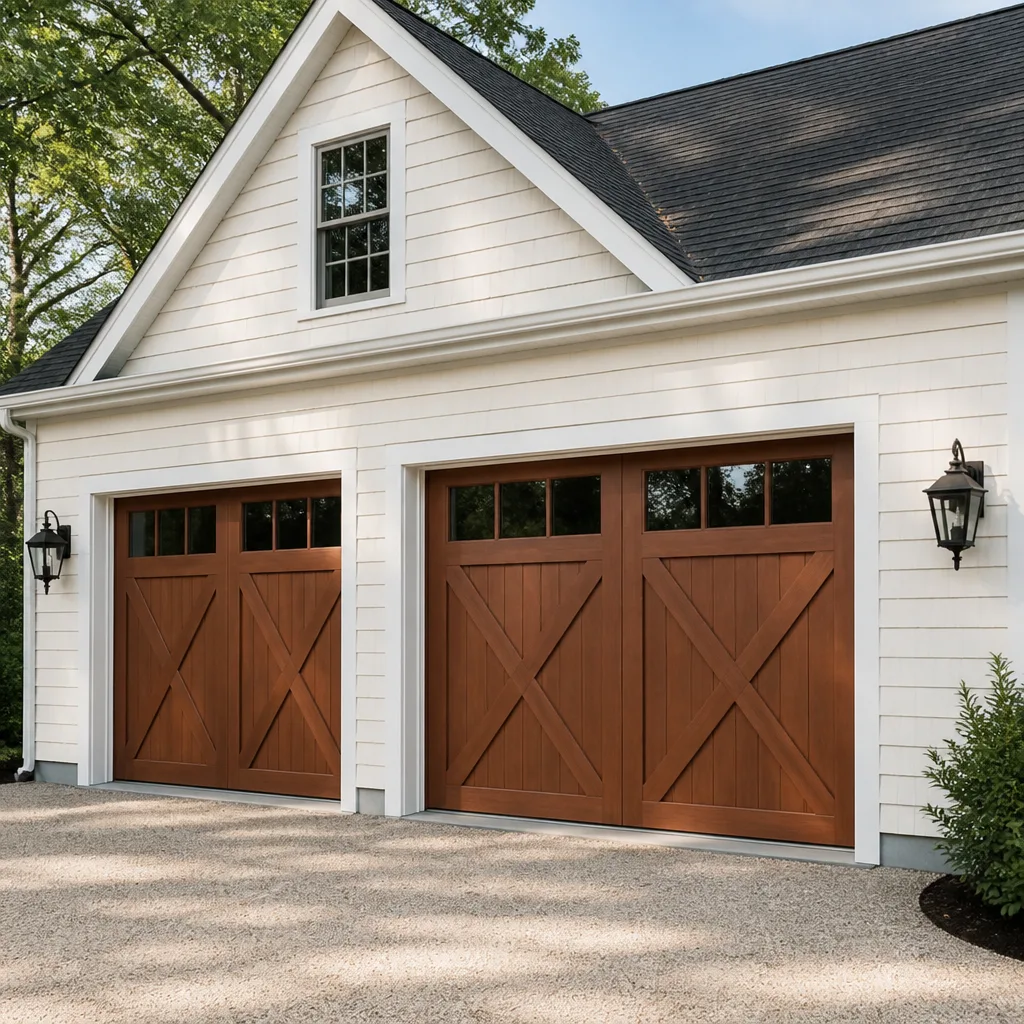 Carriage house
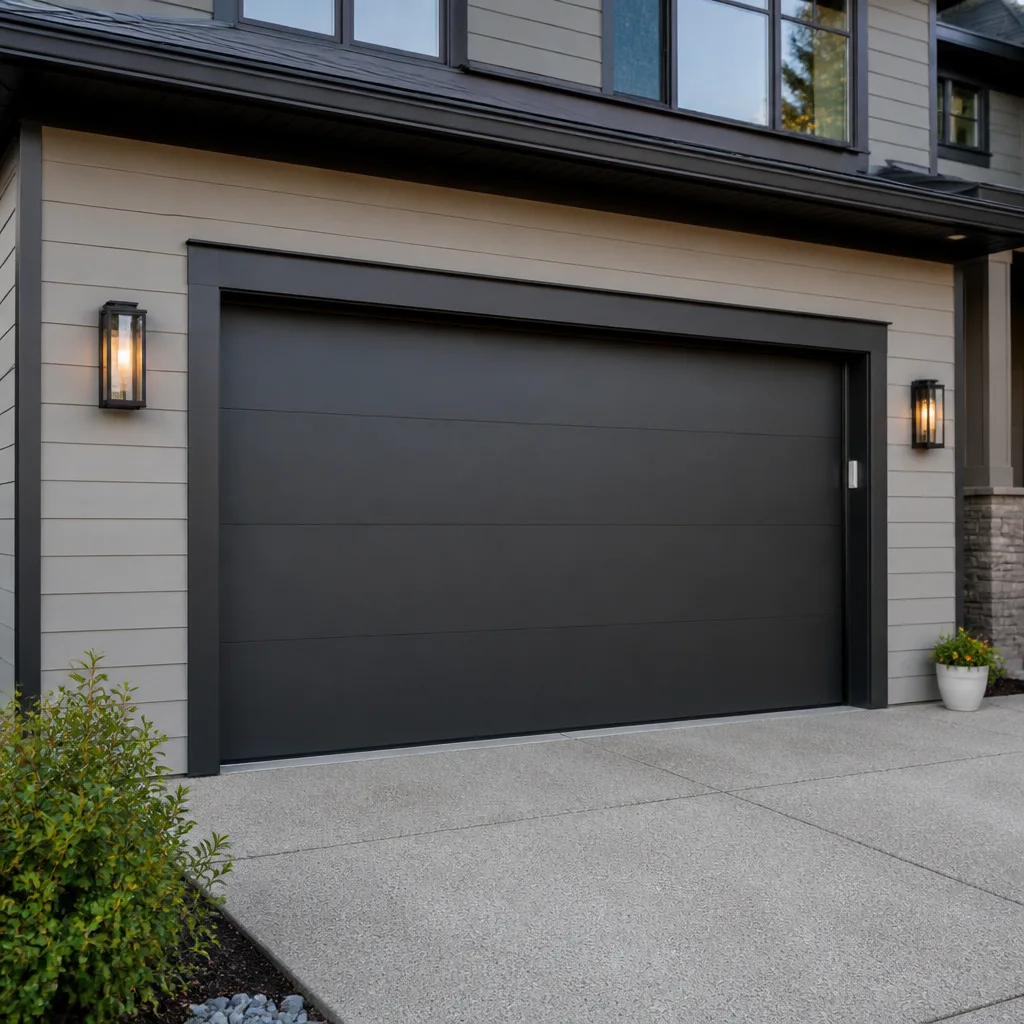 Modern flush
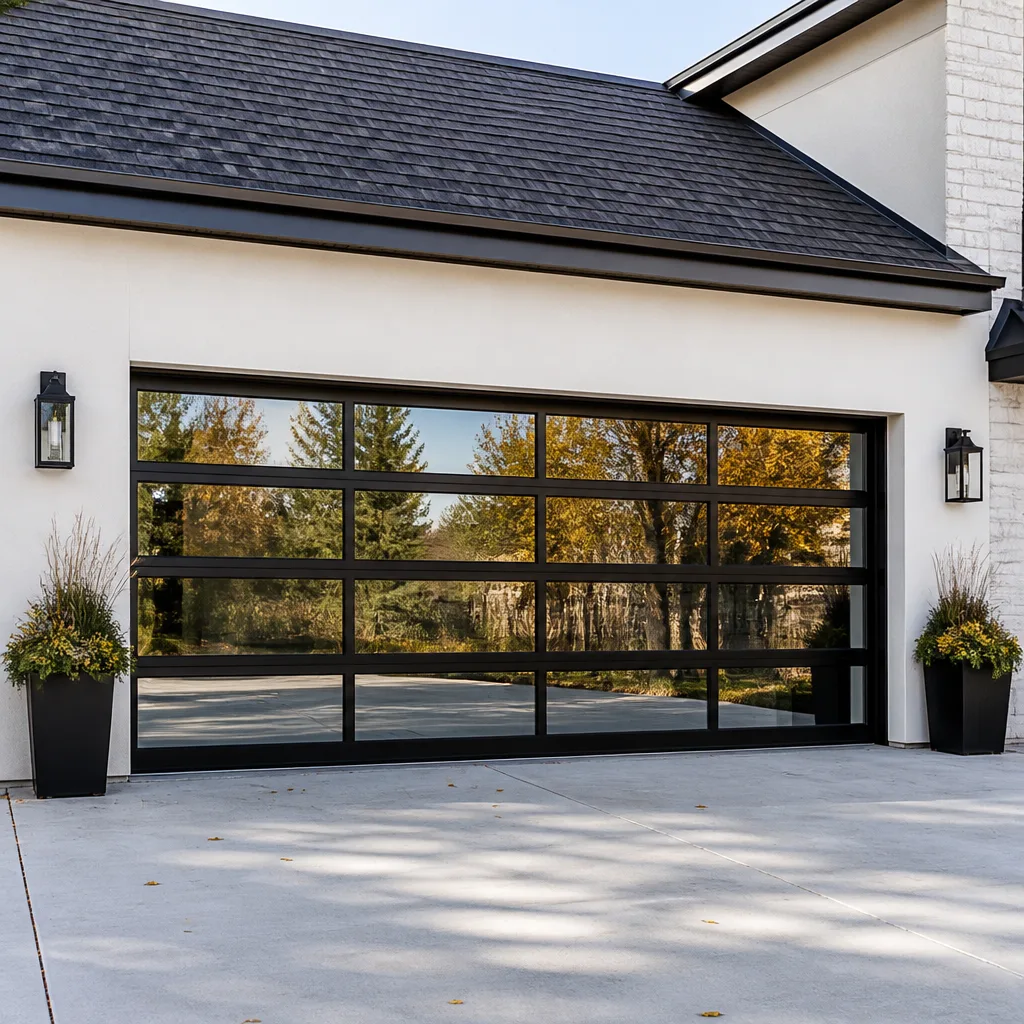 Full-view glass
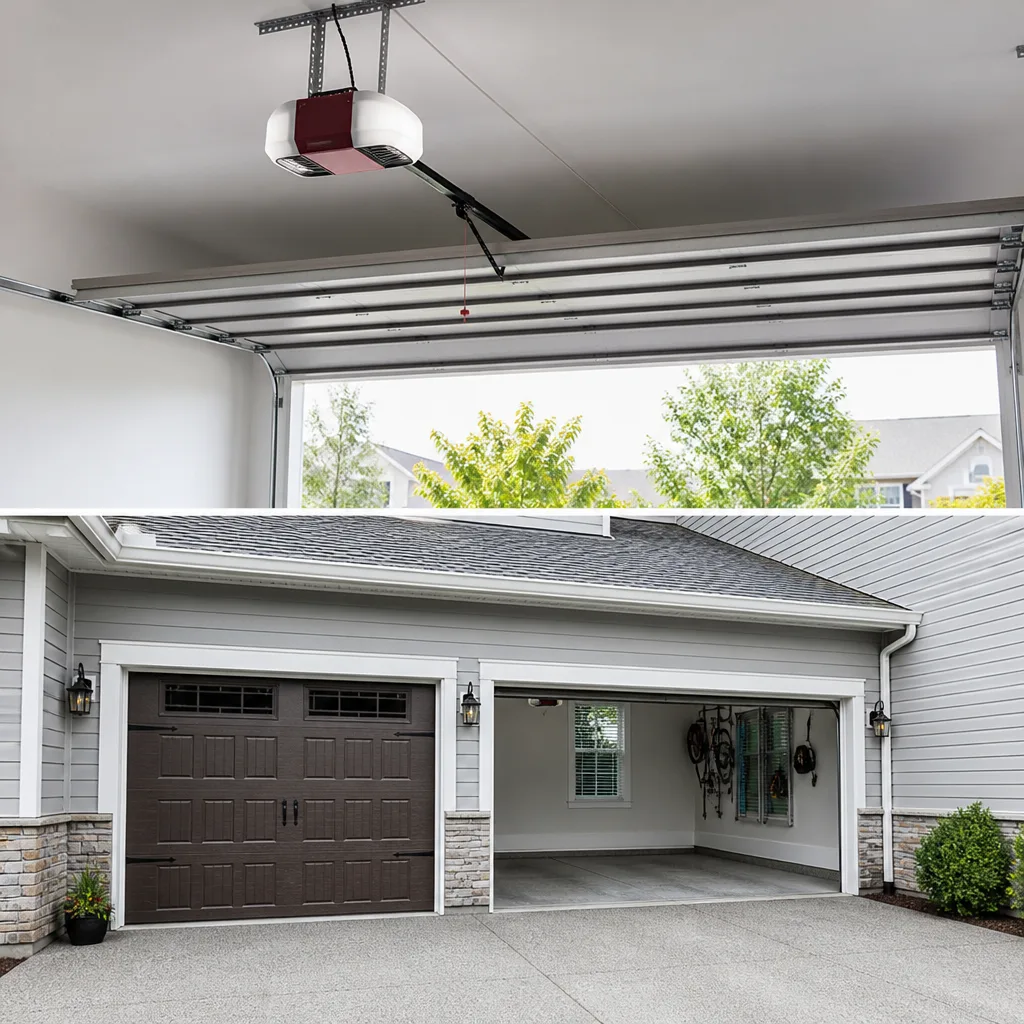 LiftMaster openers
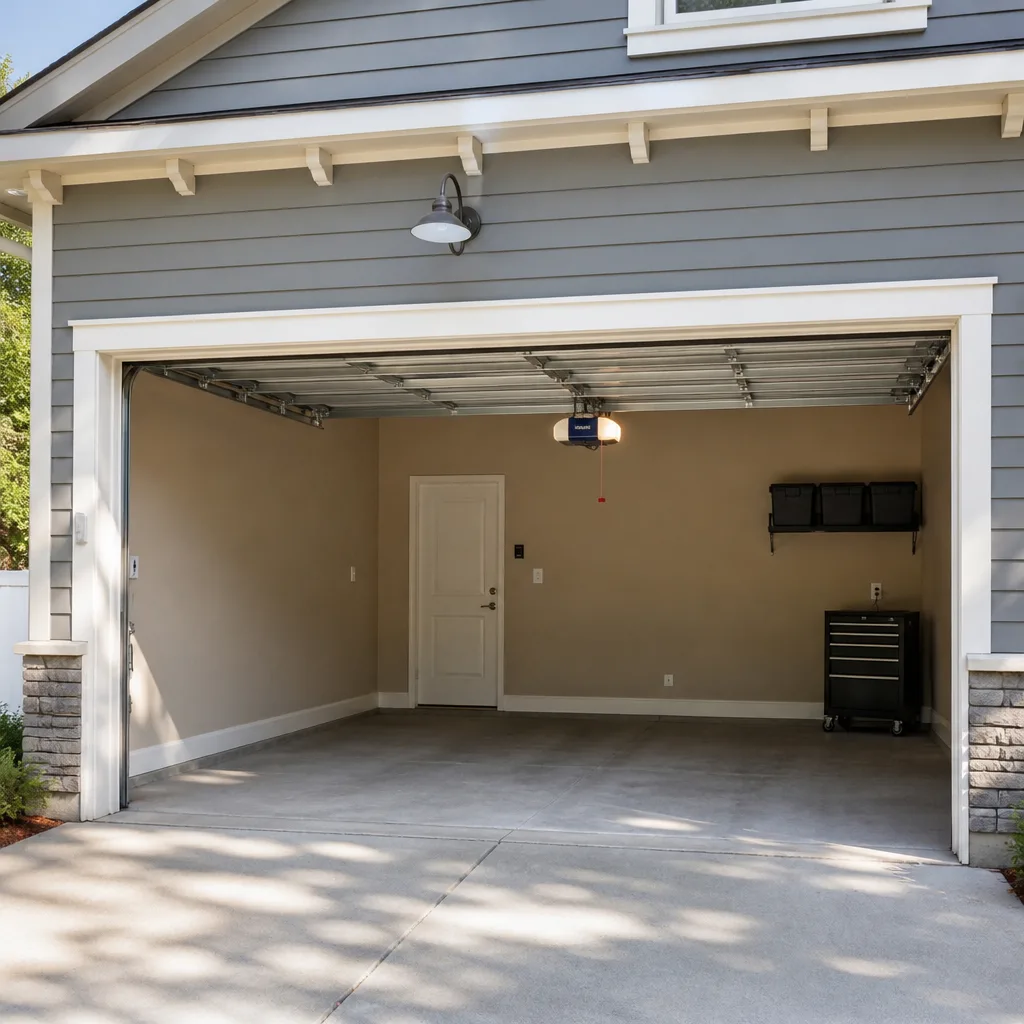 Chamberlain openers
Full 25-point door and opener safety check with every visit - springs, cables, rollers, tracks, and your LiftMaster or Chamberlain opener included
You get a price before we start. It does not change when the truck arrives.
Get your free estimateGarage Door Repair Troubleshooting: Common Problems and How to Fix Them
Here’s a counterintuitive fact we see constantly at The Villages Garage Door Service: the majority of “emergency” garage door calls we receive are for problems a homeowner could have diagnosed in under five minutes. A door that reverses right after hitting the floor is almost never a broken spring. It’s usually a misaligned safety sensor, a two-minute fix, yet it’s one of the top reasons homeowners call for emergency service and pay a premium for what amounts to a gentle nudge of a bracket. This guide exists to close that gap. We’ll teach you how to tell a $30 fix from a $400 one before anyone ever shows up at your door, so when you do call us, you’ll know exactly what you’re describing and what a fair price should sound like.
Quick Answer
Most garage door problems fall into one of five categories: sensor misalignment, track obstruction, spring wear, opener logic failure, or cable/roller damage. You can safely diagnose and sometimes fix the first two yourself in minutes. The last three usually require our Garage Door Repair services because they involve high-tension components or electrical systems that can cause serious injury when handled incorrectly. This guide walks you through each common symptom, what it actually means, and whether you should reach for a screwdriver or a phone.
Styles & brands we work with
Table of Contents
- What the Sounds Your Door Makes Actually Mean
- Door Won’t Open: Five Causes, Five Different Fixes
- Door Reverses Immediately After Touching the Floor
- Door Opens Unevenly or Sags on One Side
- Door Opens Slowly or Labors Halfway Up
- Remote or Keypad Stopped Working, But the Wall Button Is Fine
- Door Slams When Closing or Is Unusually Loud
- Common Mistakes to Avoid
- When to Call a Professional
What the Sounds Your Door Makes Actually Mean
Garage doors talk. After working on thousands of doors in The Villages, we can identify most problems from a short audio clip. Here’s what each sound is telling you, and whether it needs attention.
Grinding or metal-on-metal scraping: This means your rollers are worn out or the track is misaligned. Rollers typically last 7 to 10 years in Florida’s humid climate, which corrodes the ball bearings inside. When they fail, the wheel stops rolling and starts dragging. Left alone, a seized roller will chew through the track, and that’s a $200 problem instead of a $40 one.
Squealing or high-pitched squeaking: This is usually dry rollers or hinges. A silicone-based lubricant applied twice a year fixes it. But if the squeal persists after lubrication, the roller bearings are failing internally. That’s not something WD-40 can fix, and you’re looking at roller replacement. We carry The Villages Garage Door Service home replacement rollers on every truck, so this is a quick fix during a routine service call.
Popping or snapping: This is the one sound you never ignore. A popping noise during operation usually means a strand of a spring or cable has snapped while others are still holding. The door may still work, but the remaining strands are now overloaded. The next failure could be sudden and violent. If you hear a pop, stop using the door and call us.
Rattling: Loose hardware. Bolts and nuts vibrate loose over years of daily cycling. A rattle usually means you should check the jamb brackets and hinges for play, but it can also indicate a failing opener mount if the noise is concentrated near the motor housing.
Door Won’t Open: Five Causes, Five Different Fixes
The single most common service call we get in The Villages is “my door won’t open.” But that phrase describes at least five completely different problems, each with a different fix and a very different price tag. Here’s how to narrow it down before you call.
Cause 1: The opener is running, but the door doesn’t move
If you hear the motor running but the door stays put, your opener’s drive gear or belt is likely stripped. This is common on older LiftMaster and Craftsman units after 10 to 12 years of service. The plastic drive gear inside the opener housing is designed to fail before the motor burns out, which saves the motor but leaves you with a door that won’t budge. This is an opener repair, not a door repair, and the fix usually means replacing the gear assembly inside the unit. It’s a $150 to $250 repair on most models, which is far less than a new opener.
Cause 2: The door is frozen in the closed position
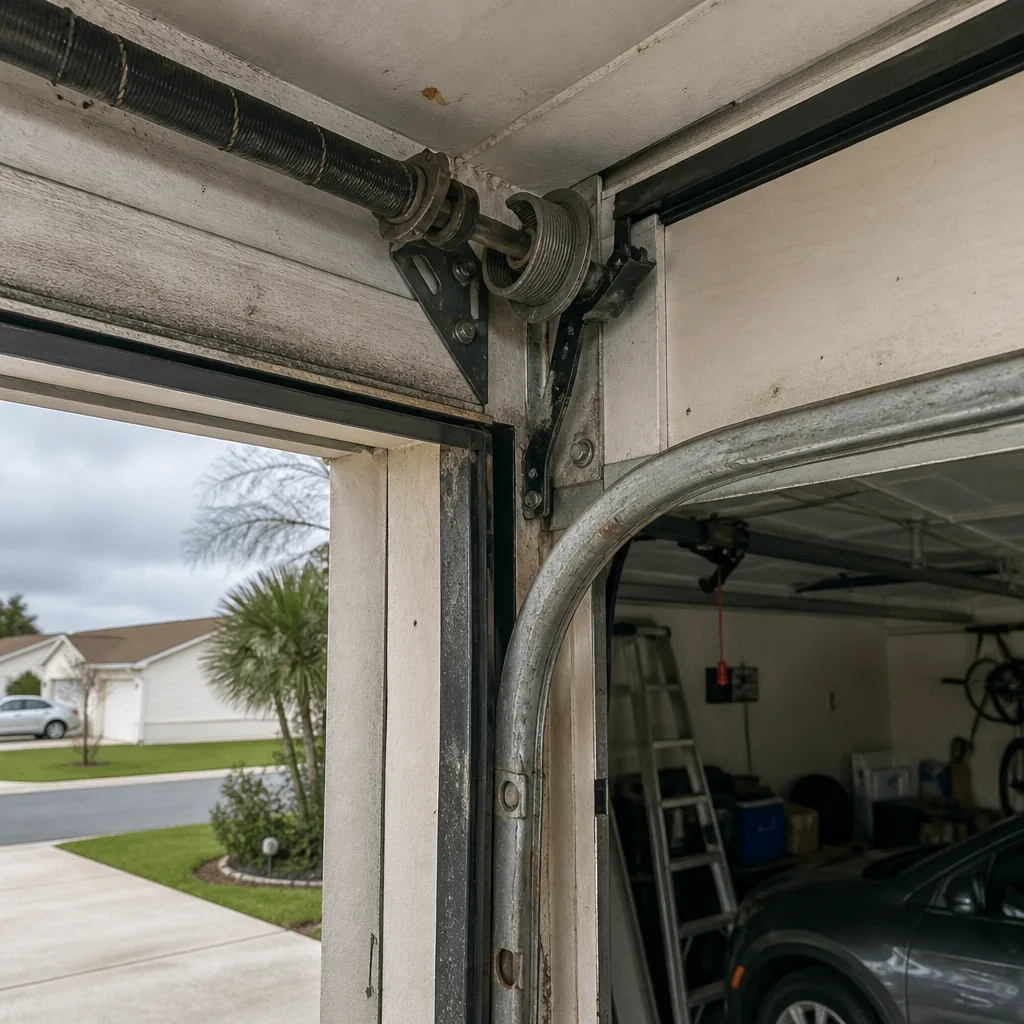
If the door won’t move at all and the opener just clicks or hums, step back and look at the springs. A broken torsion spring is the most likely culprit when a door is stuck shut. The opener motor simply isn’t strong enough to lift a door that’s lost its counterbalance. Here’s the critical safety point: torsion springs are under extreme tension. You never repair these yourself. Attempting a DIY spring replacement is one of the most dangerous home repairs a person can attempt, and it sends hundreds of people to the emergency room every year. If your spring is broken, call us. We work on torsion and extension spring systems across Wayne Dalton, Clopay, Amarr, and every other major brand.
Cause 3: The opener is completely unresponsive
No sound, no movement, no lights. Start with the basics: check the breaker, check that the opener is plugged in, and check the GFCI outlet. In Florida garages, GFCI outlets trip frequently during thunderstorms and high-humidity periods, which is a surprisingly common cause of “dead” openers in The Villages. If the outlet is fine, the opener’s control board may have failed. Genie and Chamberlain units made before 2012 are particularly prone to capacitor failures after power surges. A board replacement runs $120 to $200, while a new opener starts around $350 installed.
Cause 4: The manual release was pulled and now nothing engages
If you pulled the red emergency release cord and now the door won’t reconnect to the opener, this is usually a simple fix. Run the opener through a full cycle while the door is in the down position. Most openers will re-engage automatically. If that doesn’t work, you may have a broken release mechanism inside the carriage, which is a $75 to $120 repair on most models.
Cause 5: The door is stuck halfway, and the opener lights are flashing
Flashing lights on your opener are a diagnostic code, not a random failure. Consult your opener’s manual for the specific pattern. A single flash on LiftMaster and Chamberlain units means a sensor issue. Four flashes means a door obstruction detected. Five flashes usually indicates a motor overload. Knowing your opener’s code before you call saves an entire diagnostic visit, which is why we ask about it on the phone. Our Garage Door Opener Repair in Mascotte service covers these logic-board and sensor faults specifically, and we’d rather you tell us the code than guess.
Door Reverses Immediately After Touching the Floor
This is the problem we opened this guide with because it’s the most misdiagnosed issue in residential garage doors. A door that hits the floor and immediately reverses is almost never a spring problem. It’s a sensor or limit-switch issue, and here’s how to tell which one.
Check the safety sensors first. These are the two small devices mounted near the floor on either side of the door opening, usually four to six inches off the ground. One sends an infrared beam, the other receives it. If anything interrupts that beam, the door will refuse to stay down. The most common cause is misalignment. A pedestrian bumping into the bracket, a broom leaning against the wall, or simple vibration over time can knock one sensor a half-inch out of alignment. Fix it by loosening the wing nut on the bracket, adjusting the sensor until both small indicator lights glow solid, and tightening it back down. This truly takes two minutes.
If the sensors are aligned and the lights are solid, check the close-force and travel limit settings. Older openers have mechanical limit switches on the motor housing. Newer LiftMaster, Genie, and Raynor models have digital settings accessed through the wall control panel. If the close-force setting is too low, the opener reads the floor contact as an obstruction and reverses. Adjusting the force setting upward by one increment usually solves this. But be cautious: too much force means the door won’t reverse when it hits a real obstruction, and that’s how children and pets get injured. If you’re not comfortable adjusting these settings, this is a five-minute fix for a technician, and we can walk you through it over the phone at (855) 382-0952.
Door Opens Unevenly or Sags on One Side
An uneven door is a structural problem, not a cosmetic one. When a garage door rides up the track at an angle, it’s usually one of three issues: a broken spring, a snapped cable, or a stretched chain on the opener.
If one side of the door droops noticeably while the other side rises: you have a broken spring on one side. Torsion spring systems use either one large spring or two smaller ones. When one of a pair breaks, the remaining spring tries to lift the entire weight of the door, but it can’t. The door rises crookedly, and the strain on the remaining spring is enormous. Stop using the door immediately. Continuing to operate a door with one broken spring can snap the second spring, twist the tracks, or burn out the opener motor.
If the door looks balanced but one side lags by an inch or two: check the cables. A frayed or stretching cable on one side means that side of the door is lifting less efficiently. Cables on Wayne Dalton and Amarr doors are under constant tension, and they should always be replaced by a professional. If a cable snaps while you’re inspecting it, the recoil can cause serious injury.
If the door is new and begins to sag within a year: the issue may be the opener’s chain or belt tension. A loose chain makes the door jerk upward in steps, which looks like uneven movement. Tightening the chain is a doable homeowner task on most Craftsman and Chamberlain openers, but it requires aligning the tension correctly. Over-tightening is just as destructive as leaving it loose. We see a lot of DIY chain adjustments that created new problems in The Villages garages. If you’re unsure, a service call for chain adjustment plus a track inspection is one of the least expensive visits we make.
Door Opens Slowly or Labors Halfway Up
A slow or struggling door is often written off as “the opener getting old.” Sometimes that’s true. But more often, the opener is being asked to do more work than it should, and that’s a door problem disguised as an opener problem.
Test the door manually. Pull the red release cord while the door is closed, then lift the door by hand. It should move smoothly with moderate effort and stay in the open position on its own. If it’s heavy to lift, if it drifts downward when you release it, or if it feels like it’s fighting you, your springs are losing tension. Springs are rated for a specific number of cycles, typically 10,000, which translates to roughly 7 to 10 years of daily use in a typical home. When a spring reaches the end of its service life, it doesn’t always snap dramatically. It often simply loses tension gradually, and the first symptom is an opener that seems weaker every month. Replacing the springs restores the balance, and the opener stops straining.
If the door is easy to lift manually but the opener still struggles: the problem is in the opener itself. Grinding gears, a worn belt, or a failing capacitor can all reduce motor output. This is where brand-specific knowledge matters. A LiftMaster opener from 2010 has a completely different drive mechanism than a current Genie, and the diagnostic path is different for each. We work on Garage Door Repair in Mascotte and throughout The Villages, and our technicians arrive with the parts that match your specific model, not a generic box of “maybe it fits” inventory.
Remote or Keypad Stopped Working, But the Wall Button Is Fine
This is a classic opener repair issue, and it’s one that generalist handymen often misdiagnose. When the wall button works but the remote doesn’t, the opener’s receiver or logic board is usually the problem, not the remote itself. Here’s the diagnostic sequence we use:
- Replace the remote battery first. This sounds obvious, but we estimate that 30 percent of “remote not working” calls in The Villages are solved with a $3 battery. If you have a second remote, test it. If the second remote works, the first remote is dead and needs replacement or reprogramming.
- If neither remote works, check the keypad. If the keypad also fails, the problem is the opener’s receiver. On older units, the receiver is a separate circuit board. On newer LiftMaster, Chamberlain, and Genie openers, it’s integrated into the main logic board. Repairing this usually means a board replacement, which is $120 to $200 before labor.
- If the remote works from 10 feet but not 30 feet, check for interference. LED bulbs installed near the opener are a known source of radio interference, especially on LiftMaster models from 2015 to 2020. We’ve seen this dozens of times: a homeowner replaces a garage bulb with an LED, and suddenly the remote only works from the driveway. Replacing the LED with a garage-rated bulb fixes it instantly.
- If the remote triggers the opener but the door doesn’t move, see “Door Won’t Open” above.
Reprogramming a remote or keypad is something most homeowners can do by following the opener manual, but every brand has a different sequence. Raynor uses a different learn-button process than Chamberlain, and mixing up the steps can wipe existing remotes from memory. If you’re not sure, call us or check out How to Hire a Garage Door Contractor in The Villages: A Step-by-Step Guide. We’ll walk you through your specific model’s programming or handle it as part of a service visit.
Door Slams When Closing or Is Unusually Loud
A garage door should close like a handshake: firm but controlled. If yours slams the last few inches or sounds like a freight train throughout the cycle, something is out of adjustment. The good news is that this is usually a repair, not a replacement.
A door that slams the last foot of travel is a classic sign of a worn or broken spring, or an incorrect close-limit setting. The spring’s job is to counterbalance the door’s weight throughout the entire cycle. When the spring loses tension, that final section is uncontrolled. The door’s own weight finishes the close, and you get the slam. This can also happen if the close-limit switch is set too far, allowing the opener to run past the point where the door has already contacted the floor. Both fixes are affordable. A spring replacement for a standard double-car door typically runs $180 to $340 in our market, and a limit adjustment is even less. We’ll always walk you through the exact cost before we start any work, and the price you approve on the phone is the price you’ll see on the invoice.
General loud operation is usually a combination of factors: dry rollers, loose hardware, and a chain that’s lost tension. A full tune-up addresses all three, and it’s a service we recommend every two to three years for doors in Florida’s climate. Metal parts corrode faster here than in most of the country, and door components that would last 15 years in a dry climate often need attention in 8 to 10 years in The Villages. During a tune-up, we lubricate all moving parts with a garage-door-specific silicone lubricant (never WD-40, which attracts dirt and makes things worse), check every bolt on the track and hinges, adjust chain tension, and test the safety reversal system. The whole service takes about 45 minutes.
Common Mistakes to Avoid
- Lubricating your door with WD-40. WD-40 is a solvent, not a lubricant. It strips the existing grease from rollers and hinges, then evaporates, leaving the metal drier than before. Use a silicone-based garage door lubricant available at any hardware store for under $10. One can lasts about two years with normal use.
- Assuming any door problem means replacing the door. In our experience serving The Villages, fewer than 10 percent of service calls actually require a new door. Most issues are spring, roller, cable, or opener problems, all of which are replaceable components. The Villages Garage Door Service handles both repair and Garage Door Installation in Mascotte, which means we have no incentive to push you toward an unnecessary replacement. If repair is the honest answer, we’ll tell you that.
- Attempting DIY torsion spring replacement. We cannot state this strongly enough. Torsion springs store a literal ton of potential energy. Whether you own a Wayne Dalton, Clopay, or Amarr door, the spring you’re looking at can kill you if it releases while you’re working on it. This is not a project for a YouTube video. Professional spring replacement costs a fraction of an emergency room visit, and we’ve never had a customer regret calling us instead.
- Ignoring a door that’s out of balance because it “still works.” An unbalanced door is a door that’s already failing. Every cycle puts additional strain on the opener motor, the cables, and the track. Small problems become big ones, and a $150 spring replacement can become a $600 opener replacement if you wait long enough.
- Replacing the opener before checking the door’s balance. If your opener seems weak, disconnect the door and test it manually first, as described above. We’ve had many homeowners in The Villages spend $400 on a new opener only to realize the real problem was a spring that needed $200 of work. A balanced door is the foundation of a healthy system. The opener is just along for the ride.
When to Call a Professional
Some problems are owner-solvable. Others are not. Here’s the line: you can safely clean tracks, tighten loose hardware, align sensors, replace remote batteries, and lubricate the moving parts. You should not attempt to repair or replace torsion springs, extension springs, lift cables, or opener circuit boards. The springs and cables operate under enormous tension, and the electrical work can leave you with a fried opener or a house fire if done incorrectly. If you’ve gone through the diagnostic steps in this guide and you’re still unsure what the problem is, that’s exactly the moment to call. The Villages Garage Door Service offers free estimates in The Villages. We’ll diagnose your door, explain what’s wrong in plain English, and give you an exact price before any work begins. Reach us at (855) 382-0952.
See the difference
 Before
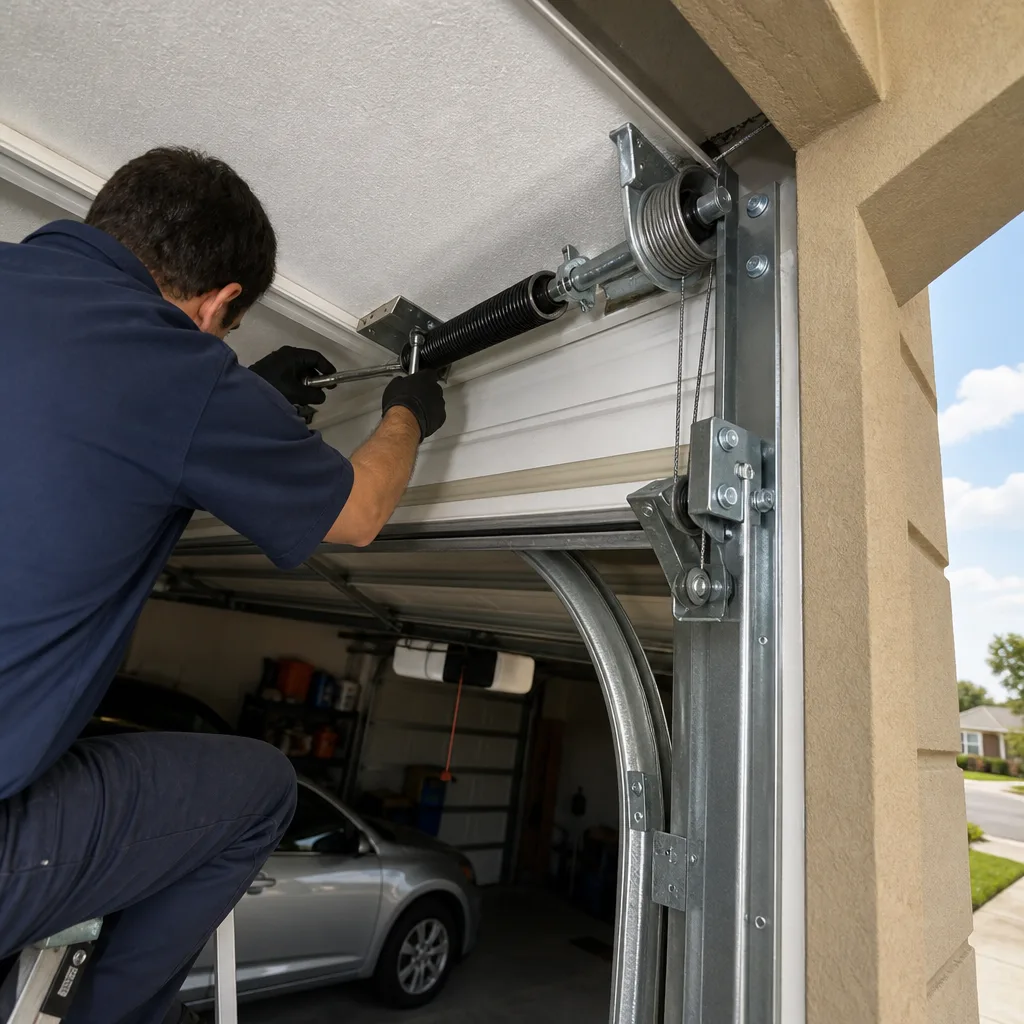 After
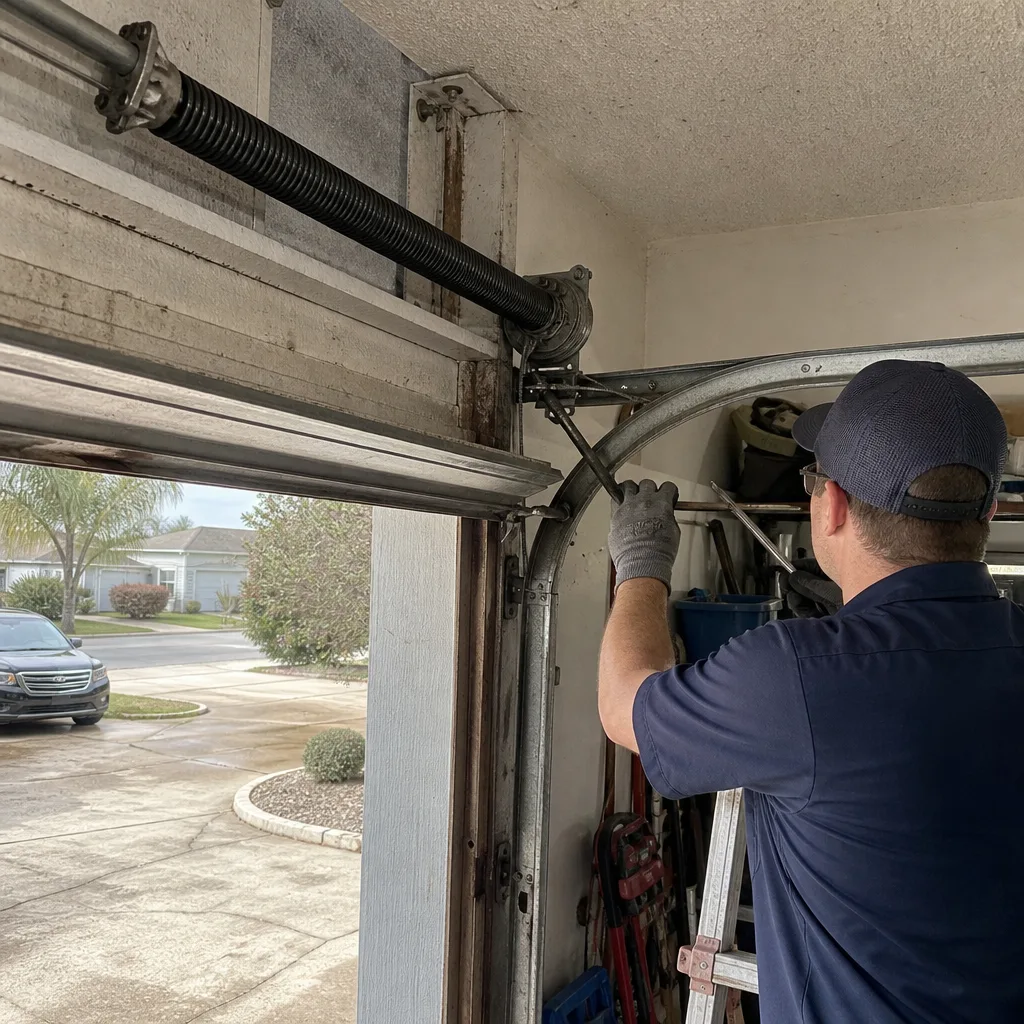 Before
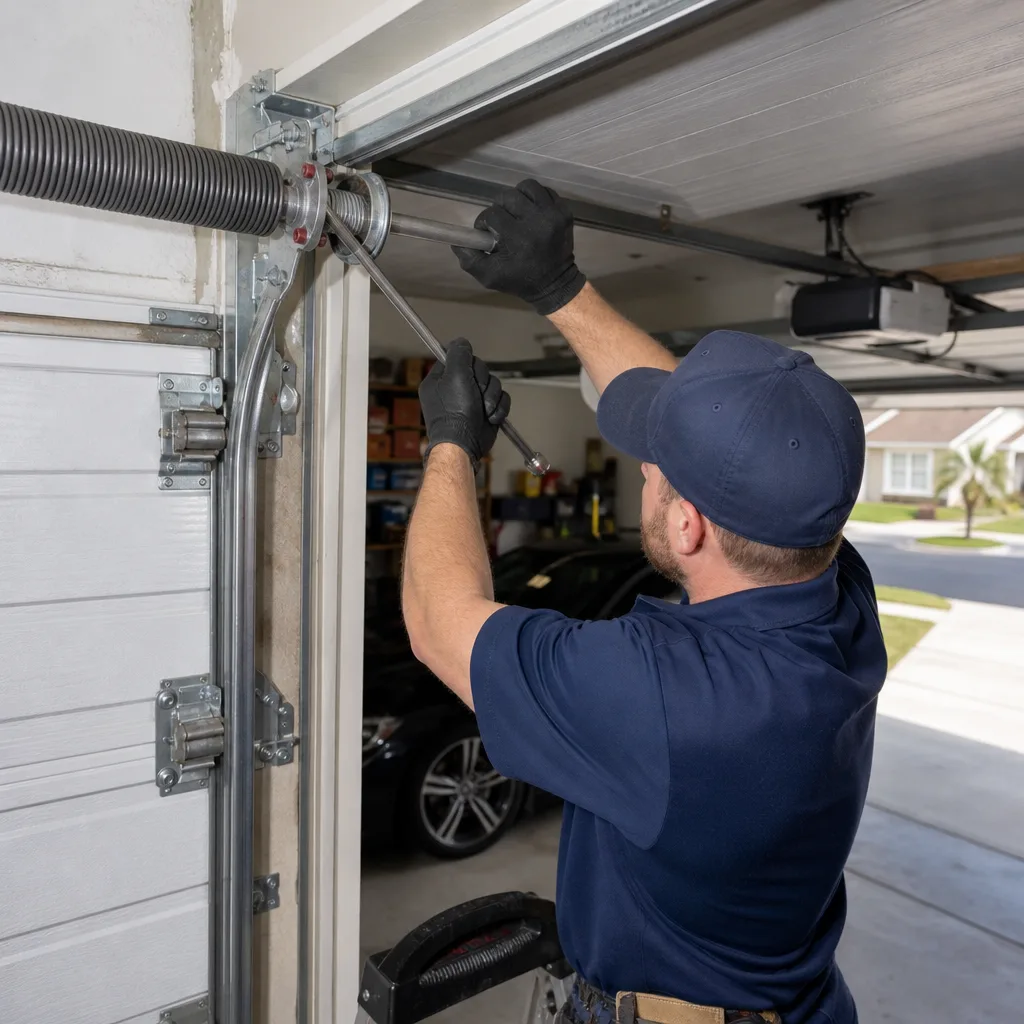 After
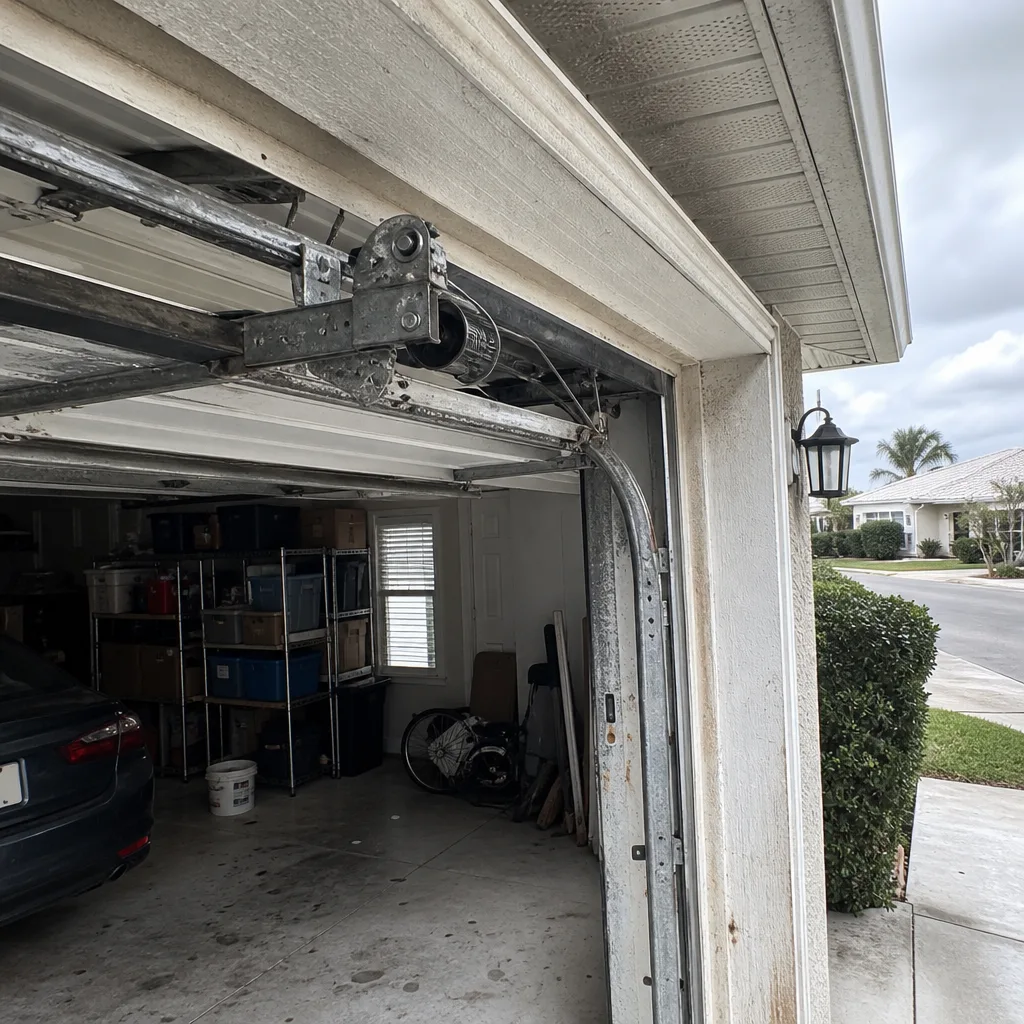 Before
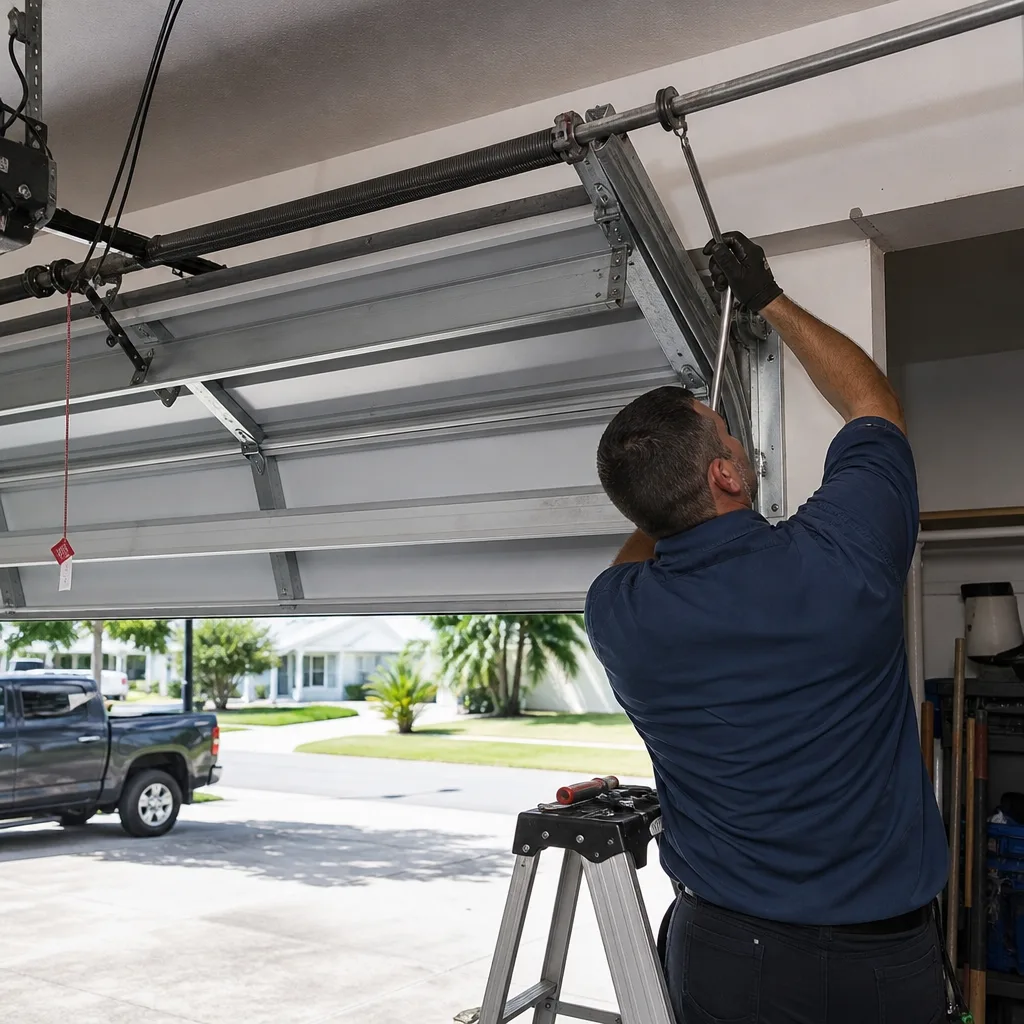 After
Frequently Asked Questions
A standard torsion spring replacement in The Villages typically runs between $180 and $340, depending on the door’s size and the spring’s cycle rating. We always quote the exact price over the phone before dispatching a technician, and that price does not change once we’re on site. Call (855) 382-0952 for an exact quote, estimates are free.
In most cases, yes. We keep a full stock of springs, cables, rollers, and other common wear parts on our trucks, so the first visit is usually the repair visit. If your problem requires parts that are specific to your door’s brand and model, we’ll tell you that honestly on the phone and schedule the return trip as quickly as possible.
We service all the major brands you’re likely to own, including LiftMaster, Chamberlain, Genie, and Raynor, plus door hardware from Wayne Dalton, Clopay, Amarr, and Craftsman. Our technicians are factory-familiar with each brand’s parts, diagnostic codes, and programming sequences, so we fix your actual system, not a generic approximation of it.
The honest answer depends on what’s wrong. A 15-year-old door with a broken spring is usually worth repairing, because springs are designed to be replaced. But a 15-year-old door with a cracked panel, rusted frame, and a corroded opener is often better off replaced. The Villages Garage Door Service handles both repair and new Garage Door Installation in Mascotte, so our recommendation is based on what’s right for your home and budget, never on what we’re able to sell you.
Intermittent operation is almost always one of three things: a failing capacitor on the opener’s logic board, a sensor that’s drifting out of alignment, or radio interference from an LED bulb or nearby wireless device. We can usually diagnose which one it is over the phone if you can describe the flashing-light pattern on your opener’s housing.
No, and here’s why. A halfway-open garage door in Florida invites humidity, insects, and curious wildlife, and it also leaves the door’s bottom edge exposed in a way that can damage the weather seal over time. The Villages is a nature-rich community, and half-open doors are open invitations. If you want ventilation, install a screened garage vent or open a side door instead.
The Bottom Line
Garage door troubleshooting isn’t a guessing game. It’s a process of elimination, and the more precisely you can describe what your door is doing, the faster and cheaper the fix will be. Learn the sounds, test the balance, check the sensors, and explore more guides & resources to know which problems are safe to attempt and which ones deserve a professional. We built The Villages Garage Door Service around a simple idea: your neighbors deserve a garage door specialist who knows their exact brand, shows up prepared, and charges the price they quoted on the phone. Whether you’re in need of a quick tune-up, a full opener repair, or an honest conversation about replacement, one call handles it. Reach us at (855) 382-0952 and we’ll take it from there.
Written by the team at The Villages Garage Door Service, serving The Villages since 2016.