Last updated October 31, 2026
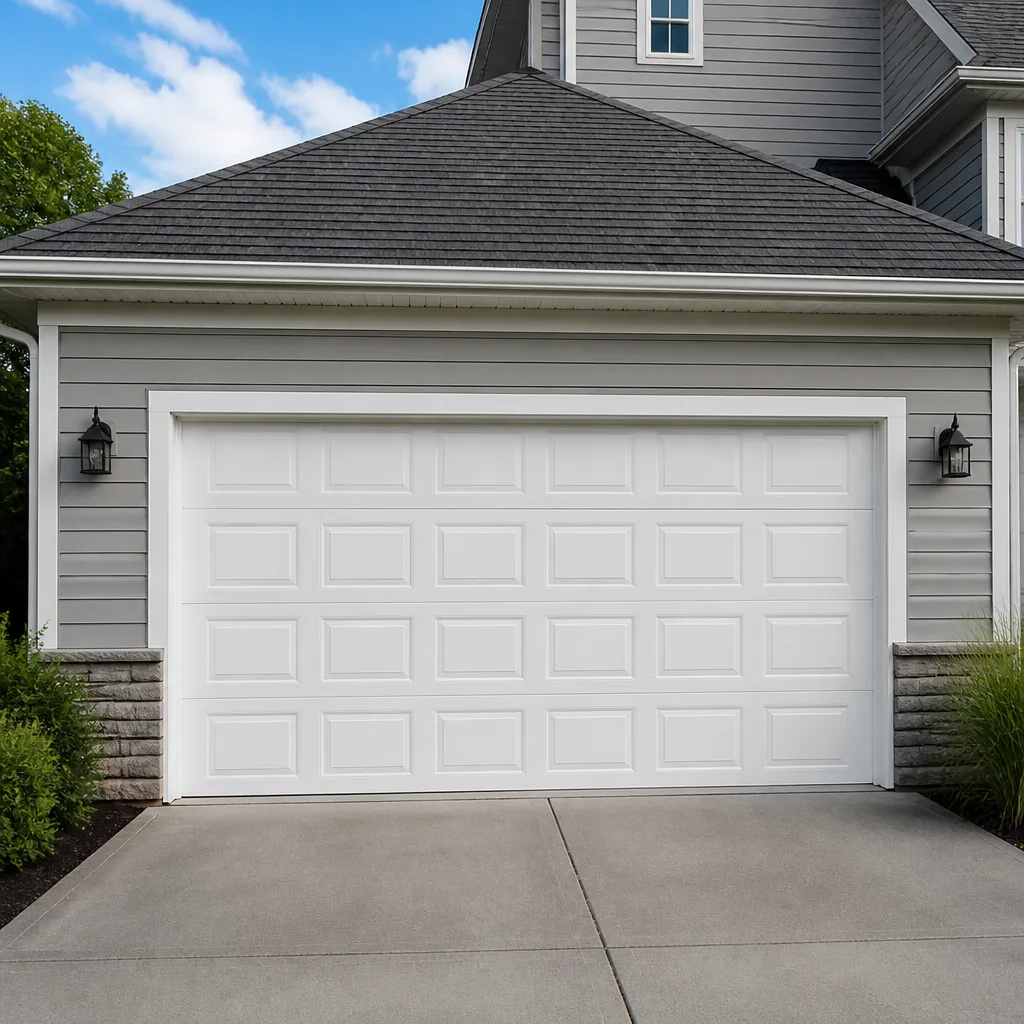 Raised-panel steel
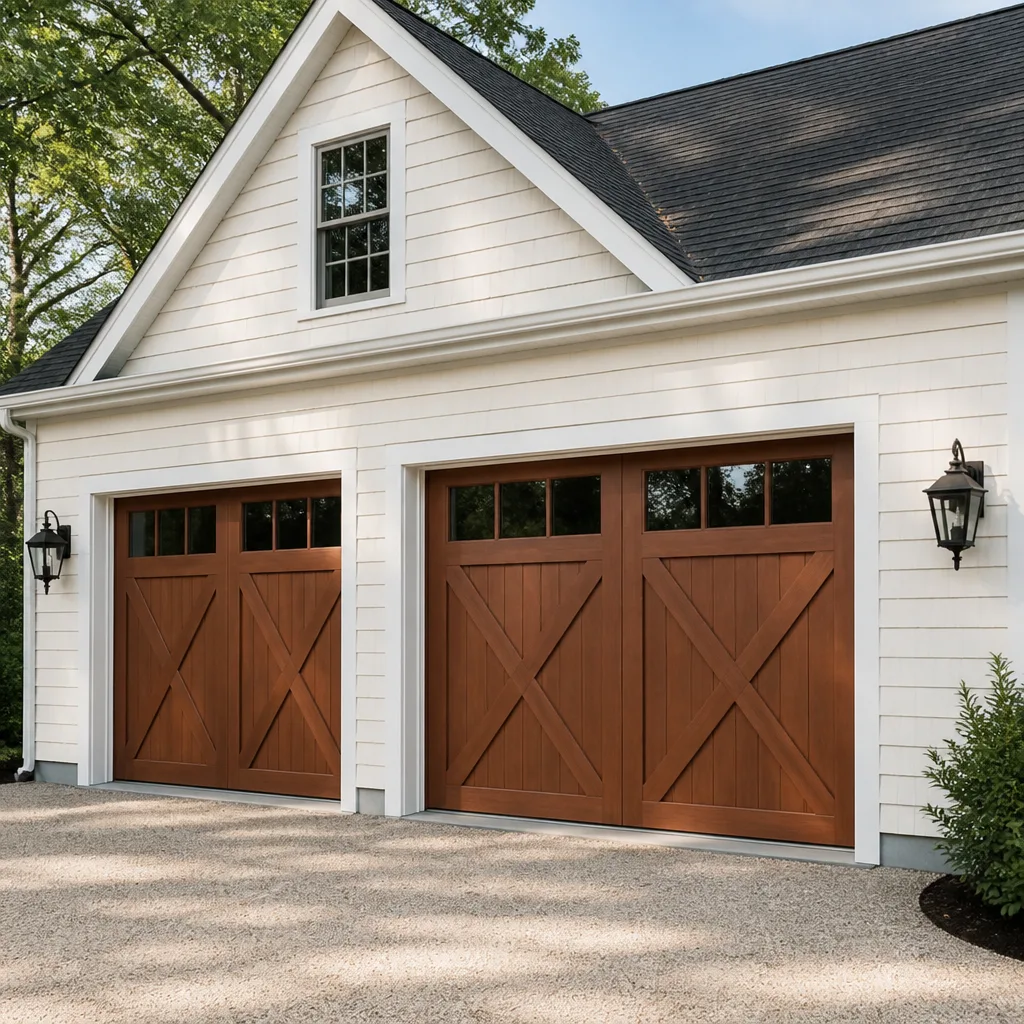 Carriage house
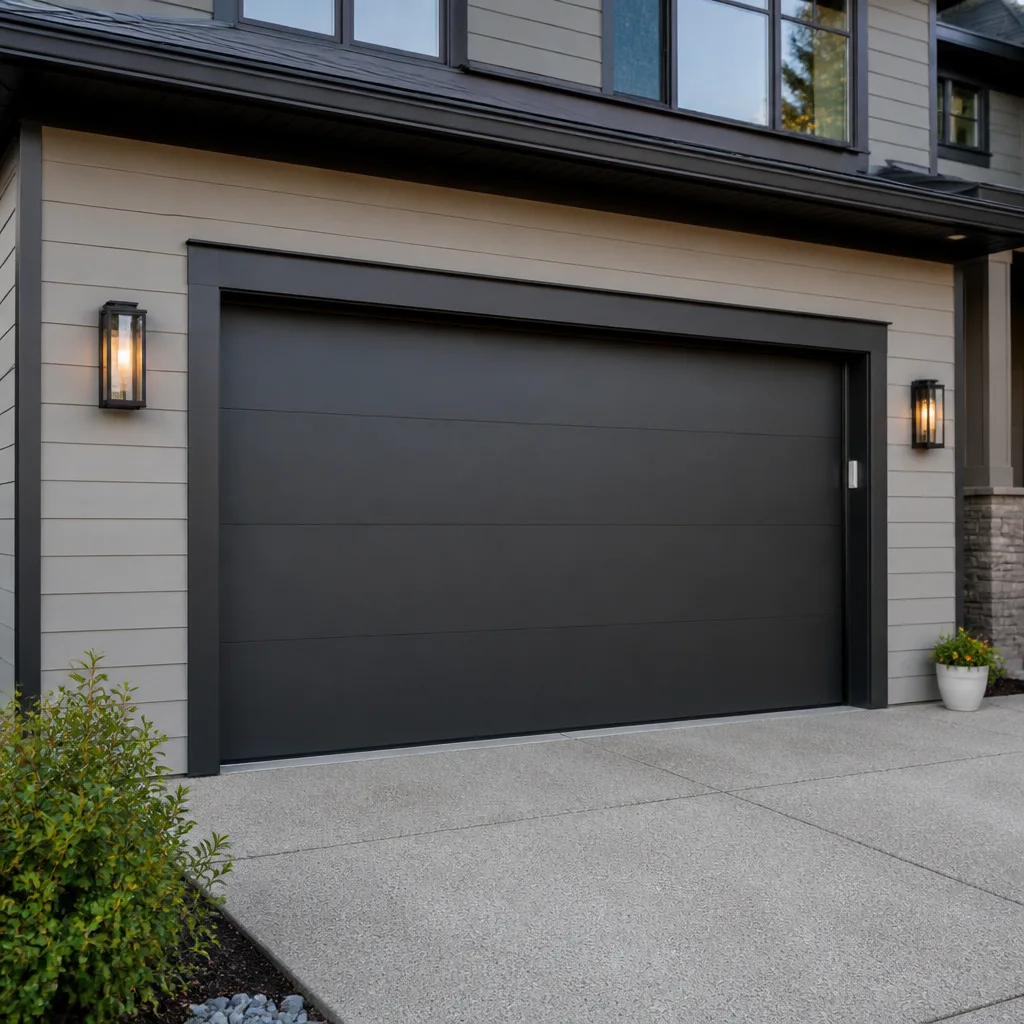 Modern flush
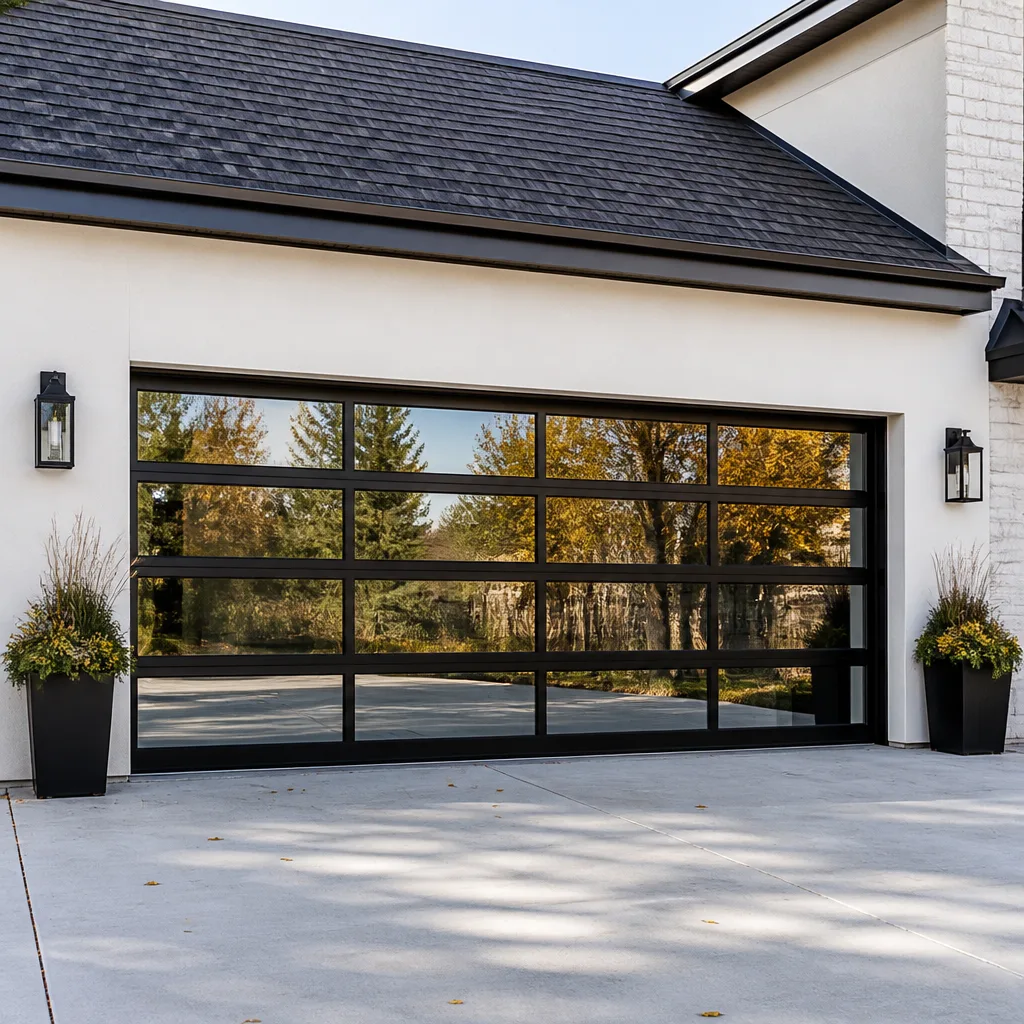 Full-view glass
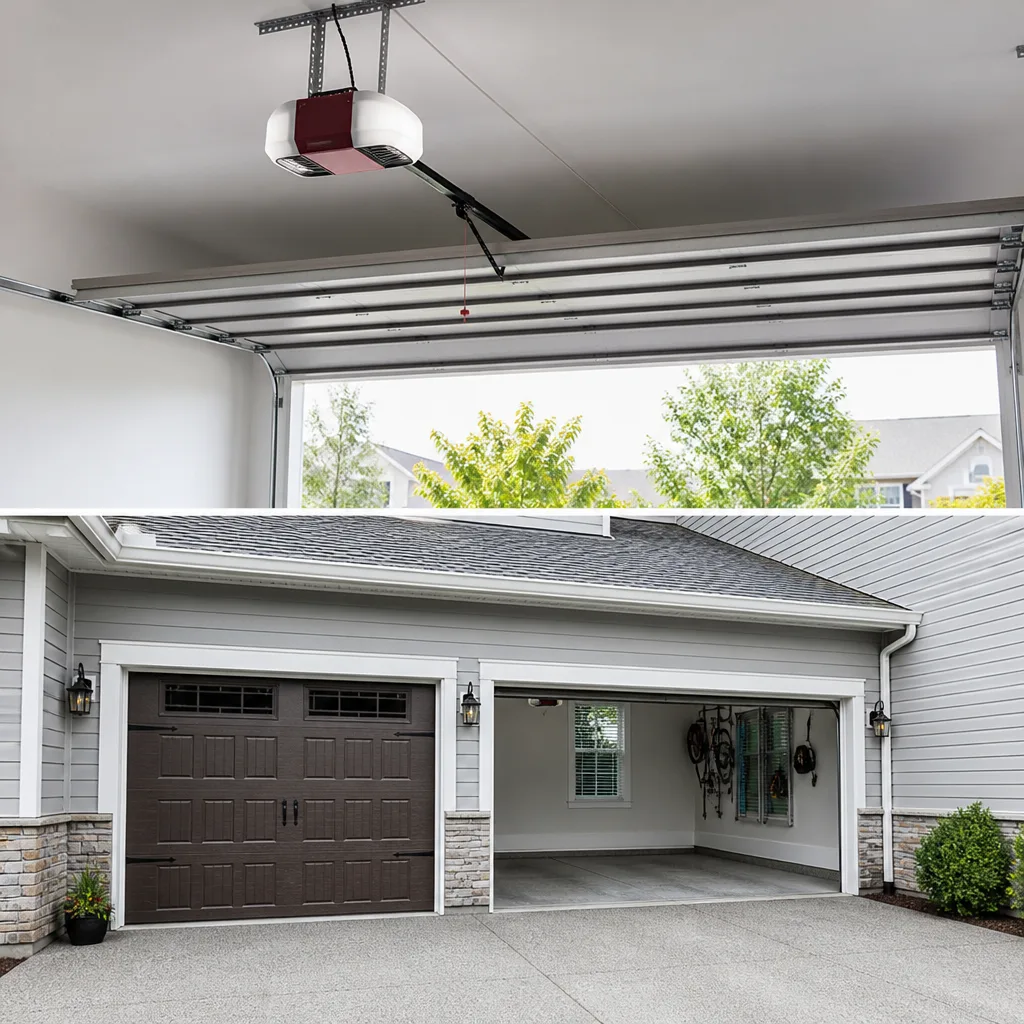 LiftMaster openers
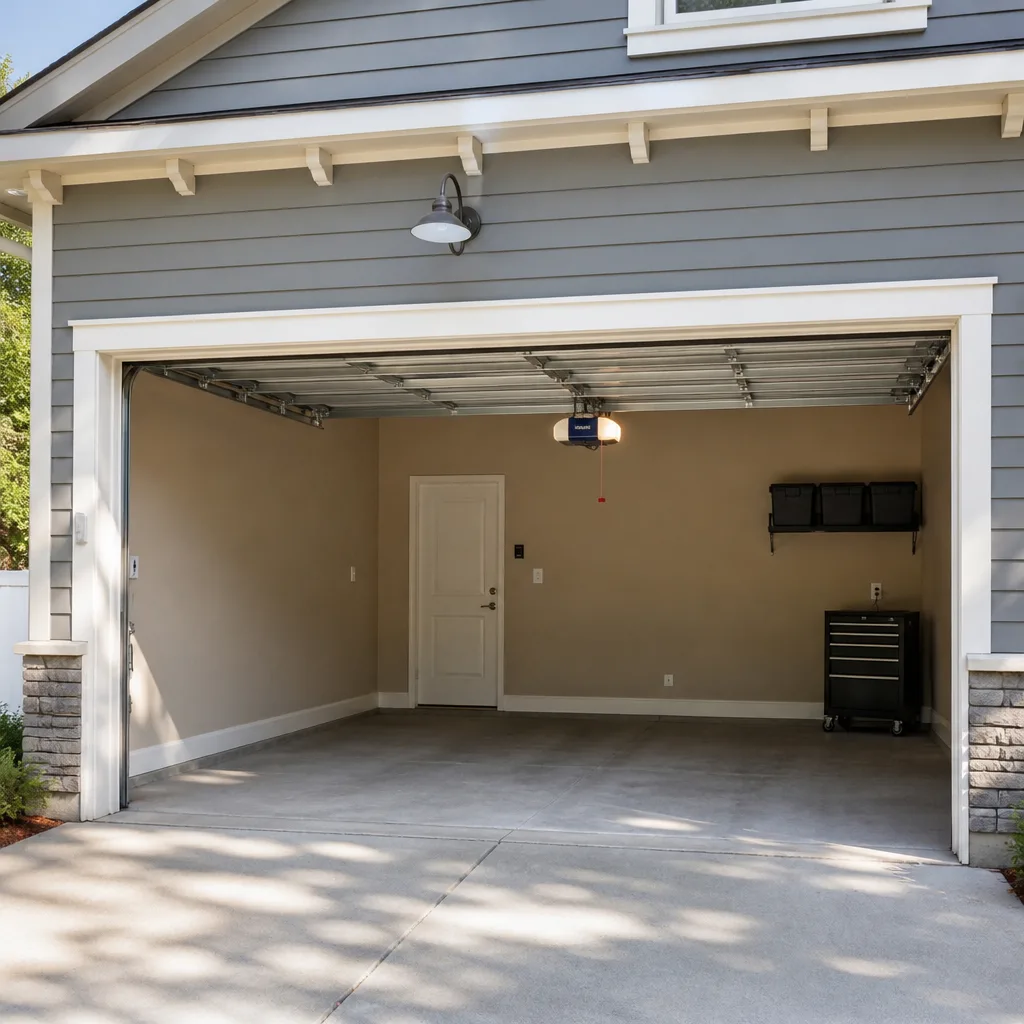 Chamberlain openers
Full 25-point door and opener safety check with every visit - springs, cables, rollers, tracks, and your LiftMaster or Chamberlain opener included
You get a price before we start. It does not change when the truck arrives.
Get your free estimateThe Complete Garage Door Repair Guide for The Villages Homeowners
Florida garage doors age differently than garage doors anywhere else in the country. The humidity that makes The Villages lush and green also works against steel springs, galvanized cables, and powder-coated panels every single day. A spring that would last 12 years in Ohio might fail in year 7 here. This guide explains why that happens, what you can do about it, and when our Garage Door Repair services make more sense than a replacement. We’re writing this from real experience serving The Villages homeowners who deal with these exact conditions.
Quick Answer
Garage door repair in The Villages typically involves spring replacement, cable repair, roller replacement, track realignment, or opener troubleshooting. Most spring and cable jobs are completed same-day by a qualified technician, while panel replacement and full door installation require ordering materials and scheduling a measure. The right fix depends on your door’s age, brand, and how much Central Florida humidity has already taken from the hardware.
Styles & brands we work with
Table of Contents
- How Florida’s Climate Damages Garage Doors
- The Most Common Garage Door Repairs
- What’s Safe to Fix Yourself (and What Isn’t)
- HOA Considerations in The Villages
- Repair or Replace: A Lifecycle Map
- Garage Door Opener Repair: A Category of Its Own
- Documenting Repairs for Resale
- Common Mistakes to Avoid
How Florida’s Climate Damages Garage Doors
We replace more rusted cables and corroded springs in The Villages than anywhere else we work. The mechanism is simple: warm, moist air carries salt and condensation into your garage, where it settles on metal components overnight. Over years, that moisture weakens the galvanized coating on torsion springs, allowing rust to form inside the coil where you can’t see it. A rusted spring doesn’t fail gradually. It snaps.
What humidity does to each component
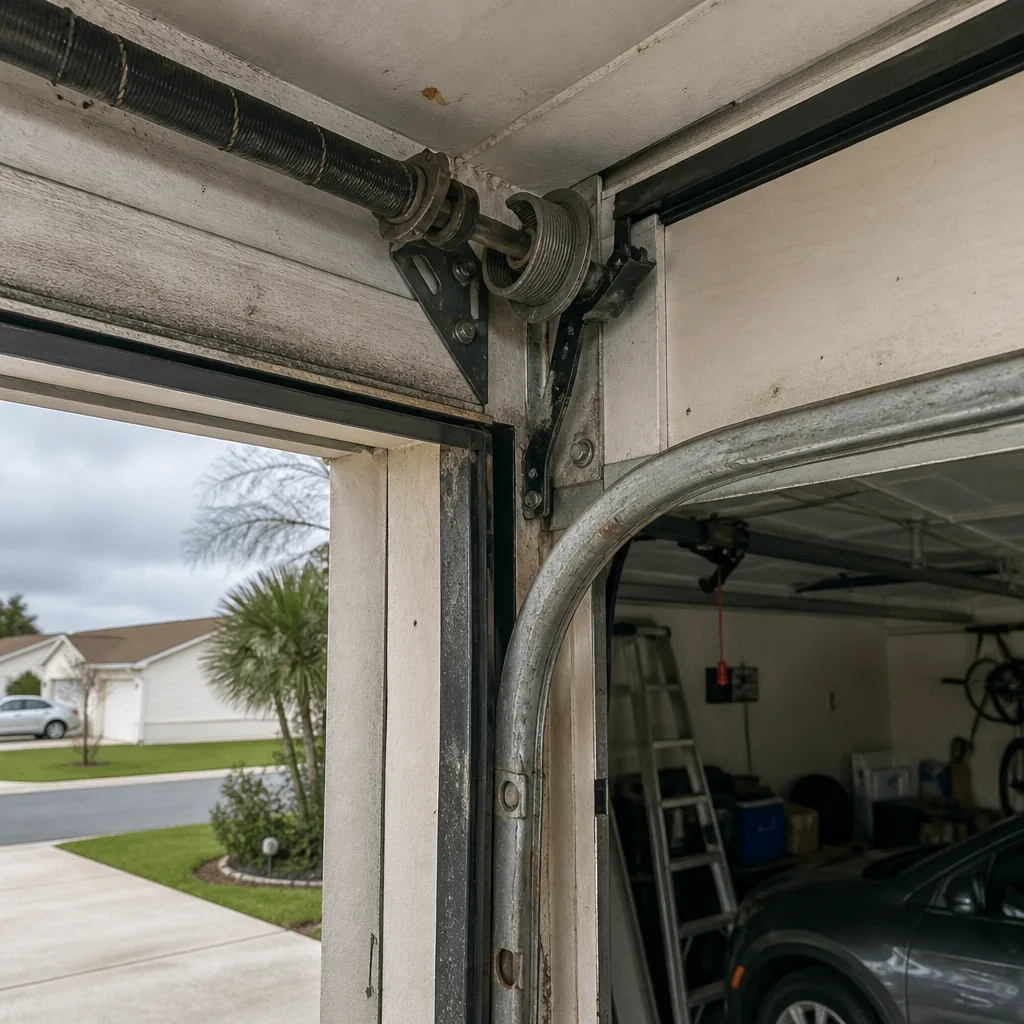
- Torsion springs: Micro-rust forms between coils, creating friction points. Each open/close cycle grinds away at the weakened steel. Most Florida spring failures happen between 6 and 9 years after installation, not the 10 to 12 years you’ll see in national guides.
- Lift cables: Galvanized aircraft cable resists rust until the coating gets scratched during installation or from a misaligned pulley. Once bare steel is exposed to Florida air, corrosion accelerates fast. We’ve seen cables snap within 4 years of a sloppy install.
- Rollers: Nylon rollers handle humidity well. Cheap steel rollers do not. If your garage door sounds like it’s grinding gravel, you probably have seized steel rollers.
- Panels: Steel panels with quality factory primer and paint finish hold up reasonably well. Older wooden doors, still common in some Villages neighborhoods, warp and rot at the bottom edge where water pools after rain.
- Hinges and brackets: The mounting hardware is often the first thing to show rust. Surface rust on hinges isn’t a structural emergency, but seized hinges force the door to work harder and stress the spring system.
What material choices counteract humidity
If you’re replacing hardware or a full door in The Villages, material selection matters more than brand loyalty. Galvanized springs with a rust-inhibiting coating outperform standard oil-tempered springs in humid environments. Nylon rollers with sealed bearings last longer than steel. For full door replacement, factory-finished aluminum or powder-coated steel with a rust-through warranty is the right call for Central Florida. Don’t install an unfinished or raw wood door here. It will look bad in three years and need replacement in eight.
The Most Common Garage Door Repairs
Most garage door issues fall into a predictable set of categories. We’ll walk through each one, what it costs in the current The Villages market, and how to tell if you’re dealing with that specific problem.
1. Broken torsion spring
If you hear a loud bang from the garage that sounds like a firecracker, your torsion spring just snapped. The door will not open, even with the opener running. Torsion springs counterbalance the door’s weight, so when one fails, the opener motor is suddenly pulling dead weight. Continuing to operate the opener after a spring break can burn out the motor.
Spring replacement in The Villages typically runs $180 to $340 for a single spring, including parts and labor. If one spring breaks, the other one usually has comparable wear. Most technicians will recommend replacing both to avoid paying for another service call in six months.
2. Frayed or snapped lift cable
Cables attach the bottom of the door to the spring assembly. When one snaps, the door hangs unevenly or drops hard on one side. You’ll usually see a visible loose cable dangling. Never operate a door with a broken cable. The door can rack, bind, and fall.
Cable replacement in The Villages generally costs $150 to $275 per cable. On older doors where both cables show wear, replacing both at once is the better financial call.
3. Worn or seized rollers
Rollers guide the door through its vertical and horizontal tracks. Rollers should be replaced every 5 to 7 years in Florida’s climate if they’re steel, and every 10 to 12 years if they’re nylon. Symptoms include a rough, jerky door motion and grinding noises. Roller replacement runs $90 to $180 for a complete set, depending on roller quality.
4. Track misalignment
If your door binds mid-travel or visibly rubs the track, the track has probably shifted. This can happen from a loose bolt, a bumped track, or a door that has been forced while off-balance. Repair usually involves re-securing and realigning the track, plus retorquing all bracket bolts. Expect to pay $100 to $200 for this repair.
5. Panel damage
The Villages has golf carts everywhere, and golf carts occasionally meet garage door panels. A dented bottom panel is the most common panel repair we see. Single panel replacement can work on newer doors where the factory color is still available. On doors older than 10 years, color match becomes a problem. We’ll cover HOA color matching in a later section.
Need a local specialist who can diagnose what you’re dealing with? The Villages Garage Door Service home page covers our complete service range.
What’s Safe to Fix Yourself (and What Isn’t)
We’re the first to tell homeowners which repairs they can handle themselves. But we’re also honest about the fact that Florida heat changes the risk calculus of DIY work. Working in a 95°F garage with 70% humidity is not the same as fixing something in a cool Ohio basement. You’ll sweat more, fatigue faster, and make mistakes you wouldn’t otherwise make.
Safe DIY tasks (no spring tension involved)
- Lubricating rollers, hinges, and springs with a silicone-based garage door lubricant. Do this twice a year in Florida. It’s a 10-minute job.
- Tightening loose bolts and brackets on the track system. Use a socket wrench, not pliers.
- Replacing remote batteries and reprogramming remotes according to the manufacturer’s keypad instructions.
- Cleaning the photo-eye sensors at the bottom of the door tracks. A soft cloth and glass cleaner usually clears the obstruction signal.
- Testing the auto-reverse function by placing a 2×4 flat on the floor beneath the door. If the door doesn’t reverse on contact, stop using it and call a professional.
Never DIY these repairs
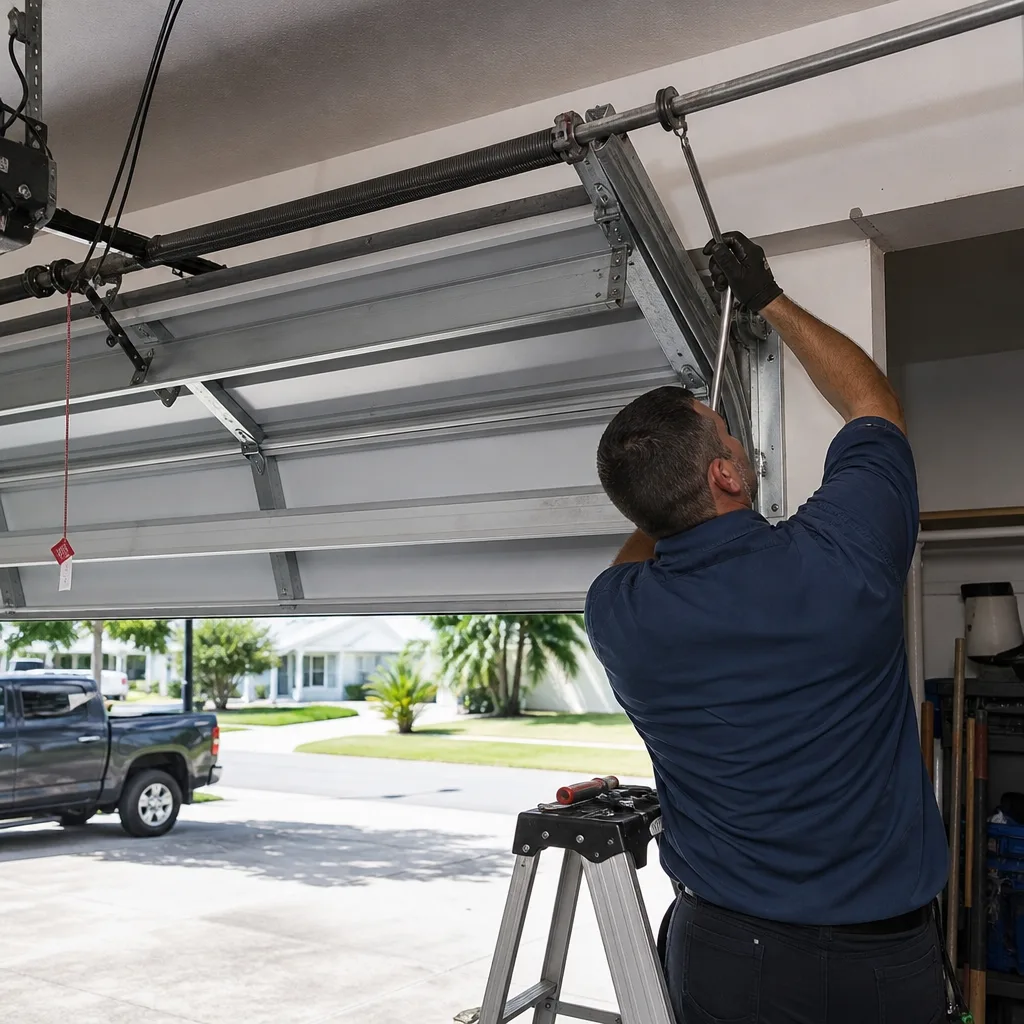
Torsion springs, extension springs, and lift cables are under extreme tension. A torsion spring that releases while you’re working on it can cause serious injury or death. The tools alone (winding bars, specifically) require training to use safely. Extension springs under tension can recoil with enough force to break bones. Cables are connected to those same springs. None of these components should be touched by a homeowner. Call a professional who carries the right tools and understands the failure modes.
We also don’t recommend DIY track realignment on a heavy double-wide door. The door weighs 150 to 250 pounds, and if it falls while you’re underneath, the consequences are severe. The heat in a Florida garage makes it harder to hold a heavy door steady while adjusting brackets. It’s not worth the risk.
HOA Considerations in The Villages
The Villages is not one HOA. It’s a collection of Community Development Districts and smaller village-level associations, each with its own architectural review process. What’s consistent across most districts is that garage doors are visible from the street, which means any panel replacement, full door replacement, or visible hardware change should be checked against your design guidelines before work begins.
Color matching and panel continuity
If a single panel is dented and needs replacement, the HOA will usually want the replacement panel to match the existing door. That sounds simple, but it isn’t. Paint fades in Florida sun. A brand-new factory panel in the original color will often look slightly different than the panels that have been outside for 8 years. We manage this by working with brands like Clopay and Amarr that maintain color archives, and by being honest about what will and won’t match. Some HOAs will approve a full repaint of an older door. Others will require full door replacement if one panel is beyond repair. We’ll help you understand what’s likely to get approved before you spend money.
Window and decorative hardware rules
Some Villages neighborhoods have specific rules about window placement and decorative hardware on garage doors. If your replacement door would change the window pattern, you may need architectural review committee approval. This is an area where a national call center will be zero help. A local installer who has worked in The Villages knows which questions to ask before the order goes in.
If you’re also dealing with opener issues alongside an HOA review, see our guide to Garage Door Opener Repair in Mascotte for specifics on the opener side.
Repair or Replace: A Lifecycle Map
Every garage door has a lifecycle in Central Florida. Understanding where yours falls helps you make a confident repair-vs-replace decision without worrying that someone is trying to upsell you. Here’s the map we use when advising The Villages homeowners.
Age 0 – 3 years: Repair almost everything
Your door is under most manufacturer warranties during this window. Broken springs, faulty openers, and cable issues are usually covered or partially covered. Even if something fails outside warranty, the rest of the door has too much life left to justify replacement. Fix the component and move on.
Age 3 – 7 years: Repair strategically
This is when Florida humidity starts claiming springs, cables, and steel rollers. These are normal wear items, not a sign that your door is failing. Replace them with upgraded materials where possible. If a spring breaks at year 5, that doesn’t mean you need a new door. It means you need a better spring.
Age 7 – 12 years: Evaluate honestly
Now we’re in the zone where the decision gets real. The door itself may still look fine, but the opener, springs, cables, and rollers are all at or near replacement age. If you’re looking at a spring replacement ($300) plus an opener replacement ($400) plus some cable work ($150) in a single year, that’s $850 into a 10-year-old door. The question becomes what else will fail in the next 24 months. There’s no single right answer, but a good technician will tell you when repair costs are approaching 50% of replacement cost.
Age 12+ years: Replace proactively
A Florida-installed door that’s 12 years or older is on borrowed time for springs, cables, and panel integrity. Rust-through at the panel bottom is common. Insulation values are lower than modern doors. If you’re in this window and facing any significant repair, replacement is usually the better financial and practical choice. You get a new warranty, modern insulation, and fresh hardware all at once.
When you need a full door replacement, Garage Door Installation in Mascotte walks through what to expect from measure to install.
Garage Door Opener Repair: A Category of Its Own
Garage door openers are the most commonly misunderstood component in the system. A general handyman might replace a broken gear but miss the logic board failure that caused the gear to strip in the first place. This is why we treat opener repair as a distinct specialty, not an add-on.
Common opener problems we diagnose
- Opener runs but door won’t move: Usually a stripped drive gear, a broken belt, or a disconnected trolley.
- Door reverses immediately after touching the floor: Travel limits need adjustment, or the close-force setting is too sensitive.
- Remote works sporadically or only at close range: Usually a logic board or antenna issue, but sometimes LED bulb interference from newer bulbs in the garage.
- Keypad won’t program or stays locked: Often a dead keypad battery or failed keypad module.
- Opener hums but doesn’t move the door: A capacitor or motor windings issue, or the opener has been trying to lift a door with a broken spring for too long.
Brand-specific opener expertise matters
LiftMaster, Chamberlain, and Genie openers all use different logic boards, travel limit systems, and wiring harnesses. A technician who mostly works on LiftMaster systems will take longer to diagnose a Genie where the travel module has failed. We work on all of these brands regularly, which means we’re not learning on your opener. We already know the failure modes for the specific unit on your ceiling. That’s the difference between a 20-minute repair and a two-hour trial-and-error session.
For a deeper dive on opener issues, see our dedicated Garage Door Opener Repair in Mascotte page.
Documenting Repairs for Resale
The Villages has one of the most active resale markets in Florida. Homes change hands constantly, and buyers here are savvier about garage doors than buyers elsewhere. Many are relocating from northern states and have never owned a Florida home before. They don’t know what normal wear looks like here, which means maintenance documentation matters.
What to keep in a garage door file
- Every repair invoice with date, technician name (if available), parts used, and any warranty on the work.
- Spring replacement records showing what type of spring was installed and its rated cycle life.
- Opener model and install date, plus any logic board or gear replacements.
- Panel repaint or replacement documentation with color codes and brand, in case the HOA asks about it during the resale review.
- Lubrication and maintenance records, even if informal. A simple note that says “lubricated hinges and springs, March 2025” tells a buyer you maintained the door.
Florida seller disclosure
Florida’s seller disclosure form asks about known defects in the property. If you’ve had a spring replaced, that’s not a defect. If you’ve been told the door has rust-through at the bottom panel and you chose not to fix it, that’s a known defect. Be honest, document everything, and a garage door repair history can actually be a selling point rather than a liability. Buyers in The Villages are attracted to homes where the previous owner kept records.
Common Mistakes to Avoid
- Continuing to run the opener after a spring breaks. Every cycle after a spring failure strains the opener motor. What should have been a $200 spring job becomes a $600 spring-and-opener job.
- Using WD-40 on garage door hardware. WD-40 is a solvent, not a lubricant. It cleans off the existing lubricant and dries out the roller bearings. Use a silicone-based garage door lubricant instead.
- Ignoring a door that’s slightly crooked when closing. That crookedness is often the first sign of a failing cable or uneven spring tension. Five minutes of diagnosis now can prevent a dropped door later.
- Replacing a panel without checking HOA requirements. In The Villages, visible exterior changes usually need review. A mismatched panel can fail inspection and cost more to fix than the original repair.
- Buying the cheapest spring replacement without asking about cycle rating. Cheap springs might be rated for 5,000 cycles. A quality spring runs 10,000 to 20,000 cycles. In Florida, that’s the difference between 4 years and 10 years of service.
- Hiring a general handyman for torsion spring work. Torsion springs require specific winding tools and training. Handymen without that training are the source of a meaningful share of the spring-related injuries we hear about.
- Skipping photo-eye sensor cleaning. Sensors get dusty fast in Florida garages. A simple cleaning clears many “opener won’t close” mystery calls without any parts replacement.
See the difference
 Before
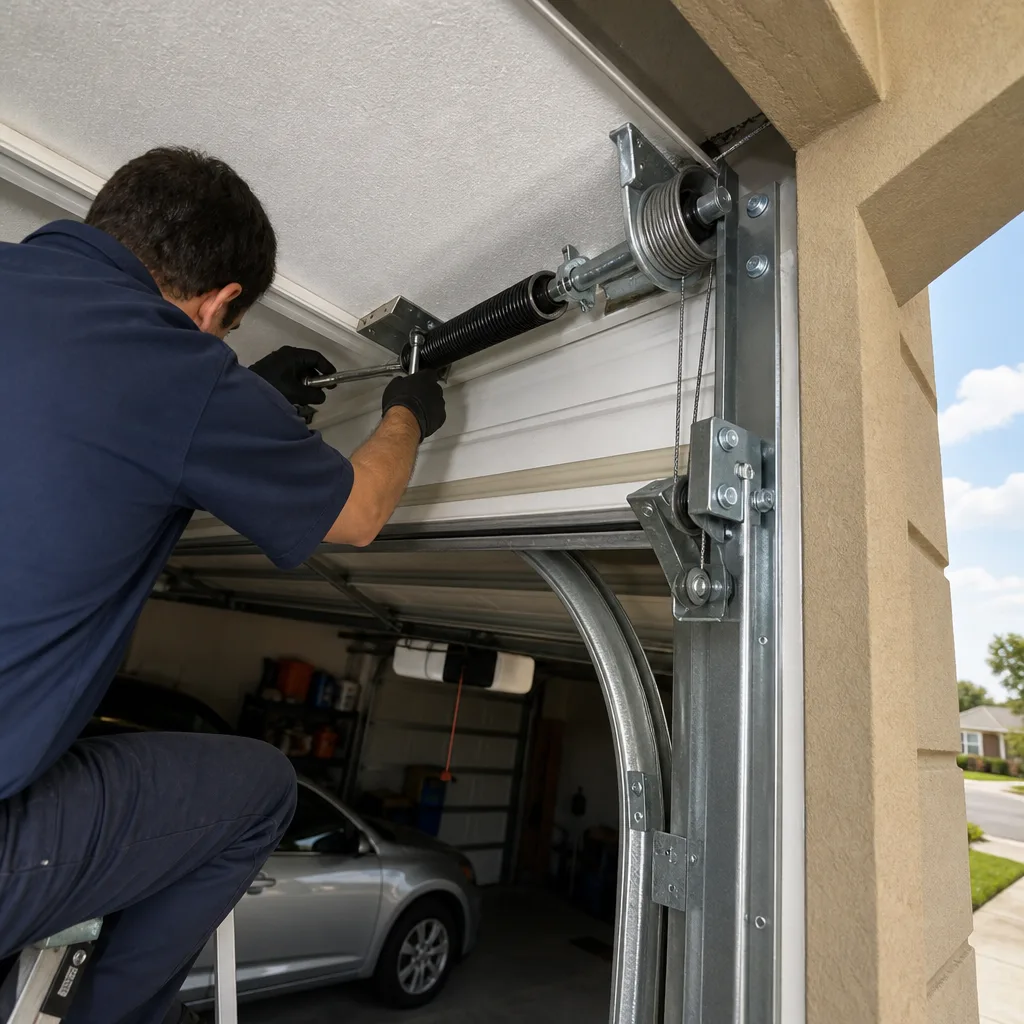 After
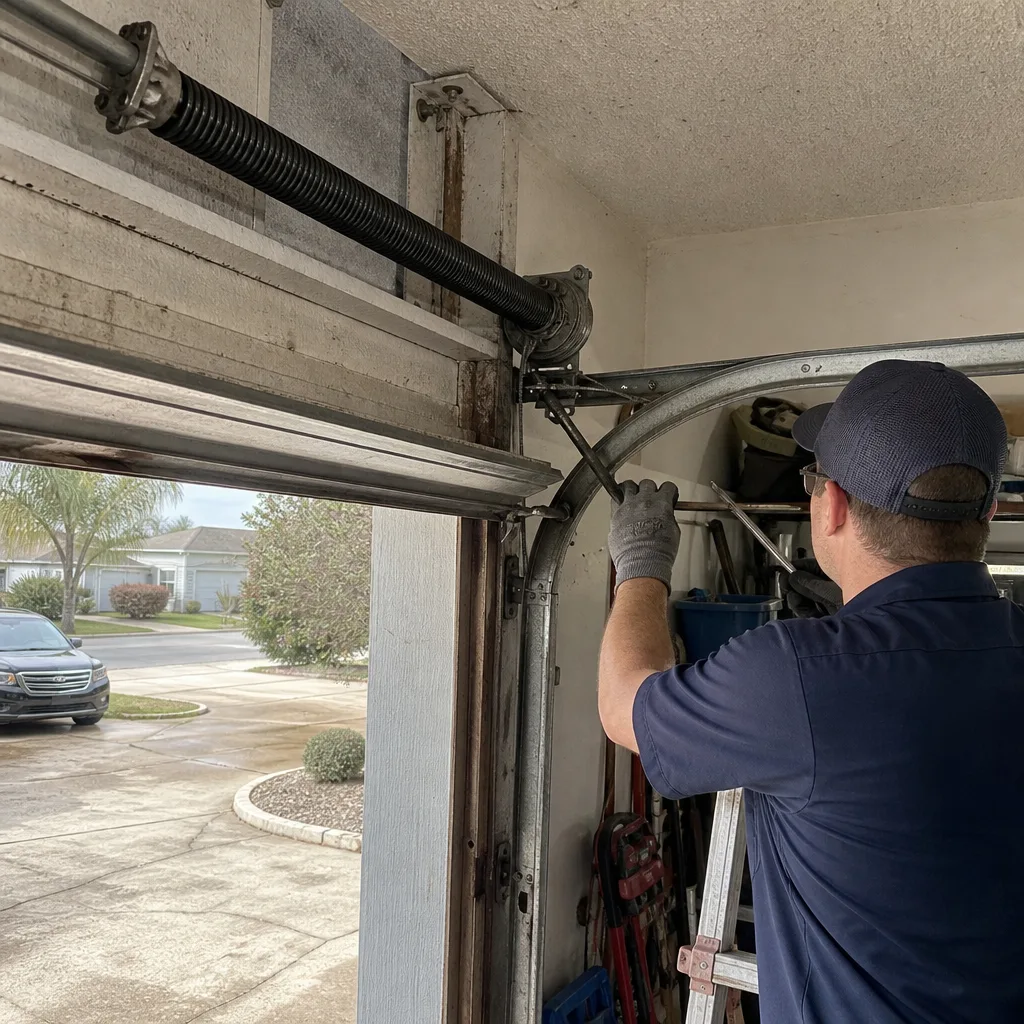 Before
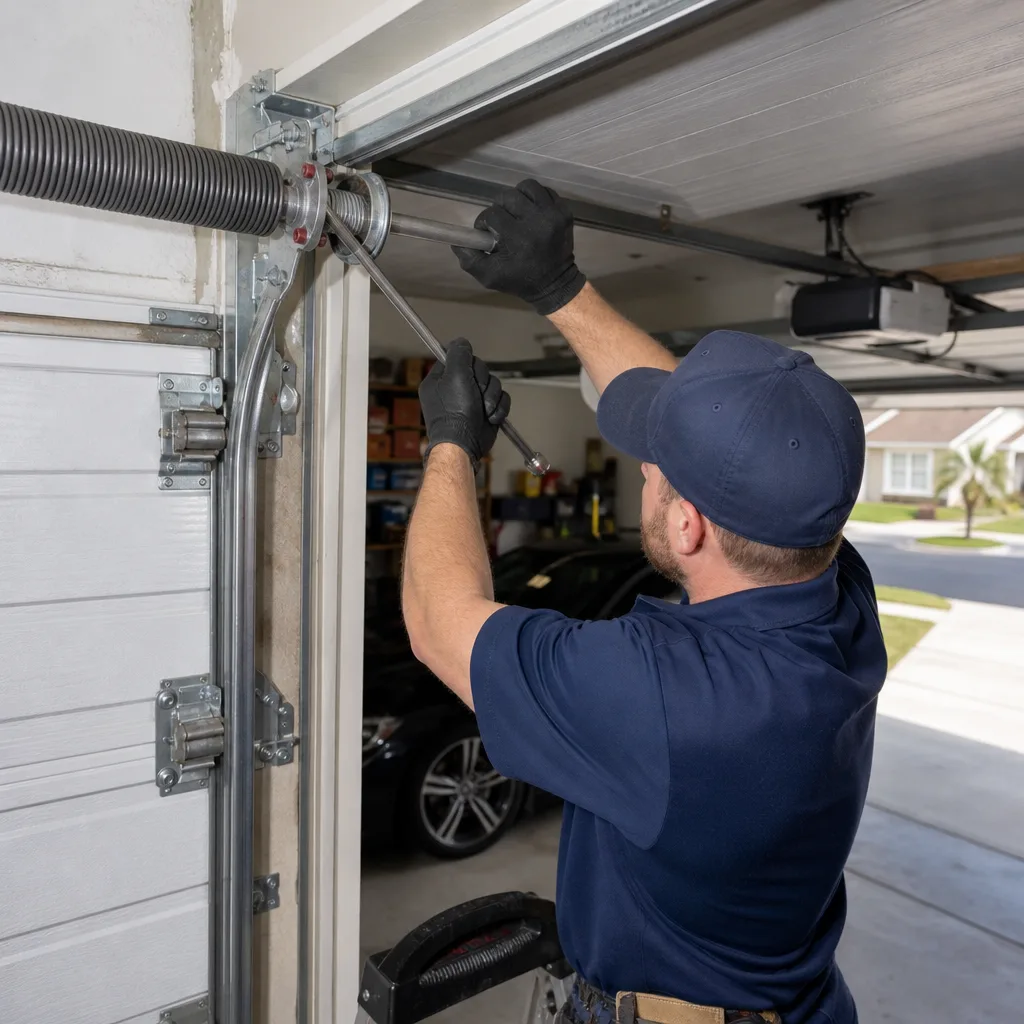 After
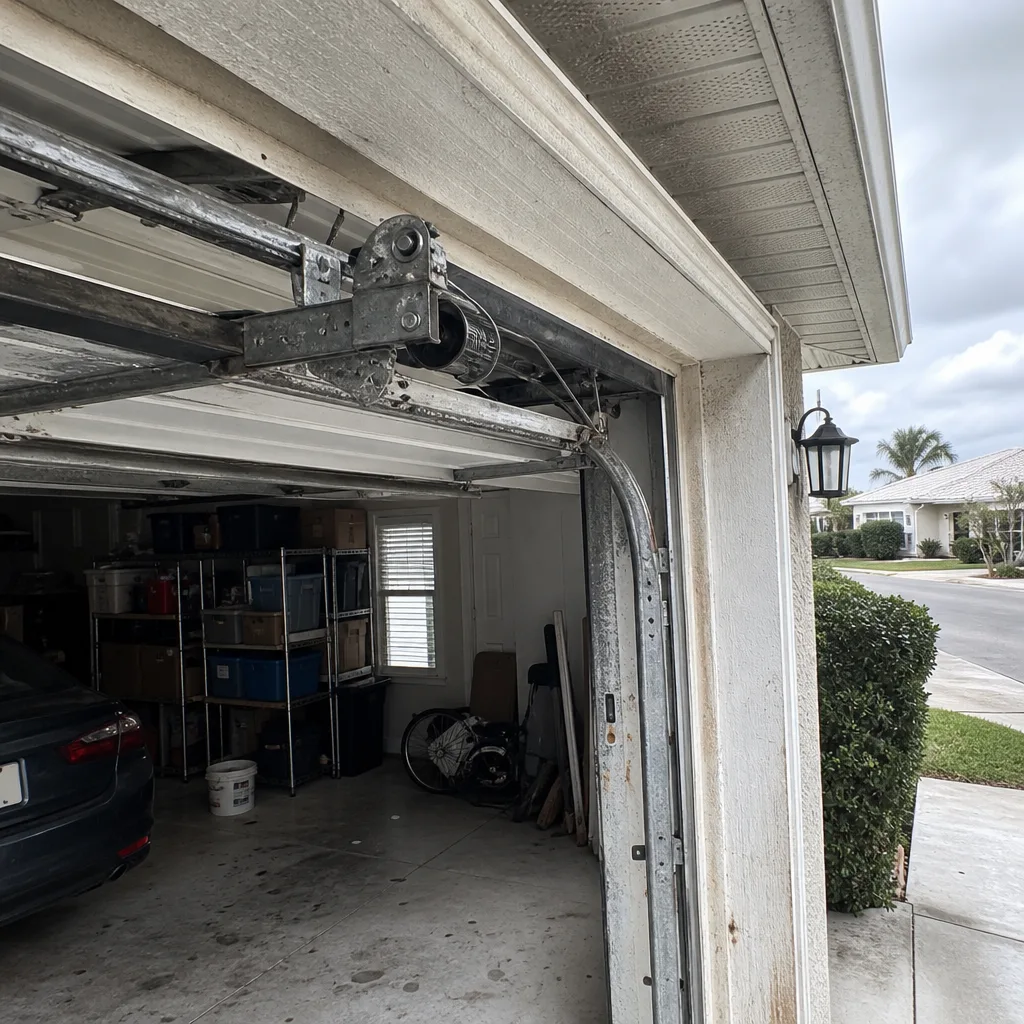 Before
 After
When to Call a Professional
Call a professional any time the repair involves a torsion spring, extension spring, lift cable, or a door that won’t stay in the open position. These components are under dangerous tension and should not be touched without proper tools and training. You should also call us if your opener is making grinding noises, if the door has come off its tracks, or if an HOA review is pushing back on a visible repair you made. The Villages Garage Door Service offers free estimates in The Villages. Call (855) 382-0952 and we’ll diagnose the issue and give you a straight answer on repair versus replacement.
For repair work specifically, see Garage Door Repair in Mascotte.
Frequently Asked Questions
Most garage door repairs in The Villages fall between $100 and $400, depending on the component. Roller replacement typically runs $90 to $180, cable replacement $150 to $275 per cable, and spring replacement $180 to $340. Opener gear or logic board repairs usually run $150 to $350. Full door replacement starts higher and depends on size, material, and window configuration. Call (855) 382-0952 for an exact quote, estimates are free.
Yes. Spring replacements, cable repairs, roller swaps, and most opener repairs can usually be completed same-day. Panel replacement and full door installation require ordering materials and scheduling a measure, so those are typically scheduled in advance. Call (855) 382-0952 to check today’s availability.
No. We quote our repair prices before any work starts, and that’s the price you pay. If the technician finds an additional issue during the repair, we’ll stop, explain what’s happening, show you the problem, and get your approval before doing anything else. The price is always agreed before work begins.
Yes. Our trucks carry common spring sizes, cables, rollers, hinges, and opener components for the brands we work on, including LiftMaster, Chamberlain, Genie, and Raynor. That’s why we can complete most same-day repairs without a second trip.
We stock parts compatible with all major brands, and we work on the brand you already own. That includes LiftMaster, Chamberlain, Genie, Clopay, Amarr, Wayne Dalton, Craftsman, and Raynor systems. For brand-specific opener work, you don’t need a second company.
We recommend lubricating rollers, hinges, and springs twice a year in The Villages, and having a full hardware inspection every two years. Florida humidity accelerates wear, so an annual quick check helps catch small problems before they become broken springs or snapped cables. The Villages Garage Door Service can handle that inspection during a routine maintenance visit. Call (855) 382-0952 to schedule.
The Bottom Line
Your garage door in The Villages is fighting a climate that most national repair guides don’t account for, which is why we created The Complete Guide to Garage Door in The Villages. Humidity corrodes hardware faster, heat fatigues springs early, and HOAs add a layer of compliance that out-of-area companies don’t understand. Repair decisions should be grounded in the specific lifecycle of a Florida-installed door, not generic national averages. Fix the right things at the right time, use materials that resist humidity, document everything for resale, and never touch a torsion spring yourself. One call to a company that knows this market saves you from guesswork. From a broken spring to a brand-new door, we handle the complete lifecycle.
Written by the team at The Villages Garage Door Service, serving The Villages since 2016. See more guides & resources for Florida homeowners.